For spaces that last longer and look better...

0507 597 9537
Support 24/7

Değirmiçem Mah. Abdullah Çolakoğlu Cad.
Kevser Apt. No:5A Şehitkamil/Gaziantep
-
Request a Quote
For spaces that last longer and look better...
Support 24/7
Değirmiçem Mah. Abdullah Çolakoğlu Cad.
Kevser Apt. No:5A Şehitkamil/Gaziantep
An antistatic epoxy floor is easy to clean and holds no dust, with moderate mechanical strength and chemical resistance. Static charge is carried out of the space through copper earthing strips built into the system. The finish can be semi-textured or fully textured. Floors go down quickly and stand up well in service.
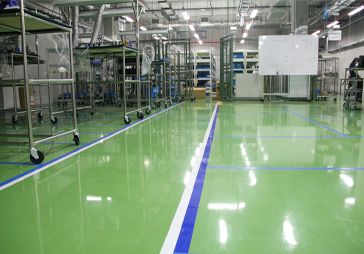
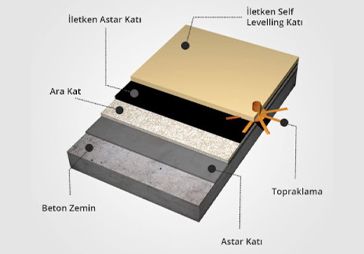
The system suits industrial floors generally — hospitals, power plants, electronics factories, the automotive sector and any surface that must not be affected by static electricity. It can be produced to the conductivity value you require, in a range of colours.
The substrate must be sound: at least 25 N/mm² compressive strength and a pull-off result of at least 1.5 N/mm². New concrete must be at least 28 days old, depending on the season, and moisture content must not exceed 5–6%. All loose and friable material, oil and paint residues and laitance must be removed, and wide cracks and defects repaired first. Laitance and polished screed are taken off by blasting, scabbling, diamond grinding or planing; the surface is then roughened and swept. The whole area is vacuumed with an industrial vacuum cleaner. Where the slab is in contact with the ground, a water and vapour barrier must already be in place.
It can be applied at low temperatures and over damp or wet concrete. Vapour permeability is high, so residual moisture in the slab does not affect it. Heat resistance is high and the finish is UV-stable.


Applied at 0.2–1.0 mm.

Applied at 1.5–4.0 mm.

Applied at 0.3–0.6 mm.

Applied at 1–3 mm.

Applied at 0.8 mm and above.

Applied at 0.8–2.0 mm.
The questions we are asked most about Antistatic (ESD) Epoxy Flooring, answered by our technical team. If something here does not cover your case, call us on 0507 597 9537.
With proper surface preparation and the right system, an epoxy floor lasts 8–15 years in industrial use. Three things decide its life: the soundness of the existing concrete, the thickness of the system chosen and the intensity of forklift and load traffic it carries.
Price depends on the area in square metres, the system chosen (coating, self-levelling, multilayer, antistatic, mortar), the film thickness and the condition of the existing slab. Grinding, repair and priming are added where the substrate needs them. HBK carries out free site surveys across the eight provinces we serve.
Foot traffic is allowed roughly 24 hours after application. Full mechanical and chemical resistance needs seven days of cure, and heavy loads or chemical contact should be kept off the floor until then.
Choose epoxy for enclosed areas where heavy mechanical load and chemical resistance come first. Choose polyurethane for outdoor areas, UV exposure, thermal shock or where the slab is likely to move and crack. Food plants washed down with hot water need Ucrete polyurethane concrete.
HBK Epoxy Flooring works from its base in Şehitkamil, Gaziantep and covers eight provinces across southern Türkiye. Our crews can travel for a survey the same day: in Gaziantep and the surrounding area we measure factory, warehouse, car park, sports hall and outdoor court projects on site and prepare a free quotation.
Districts and industrial zones we cover in Gaziantep: Şehitkamil, Şahinbey, Oğuzeli, Nizip, İslahiye, Nurdağı, Gaziantep OIZ 1, Gaziantep OIZ 2, Gaziantep OIZ 3, Gaziantep OIZ 4, Gaziantep OIZ 5, Başpınar OIZ.
For a free site survey and quotation: 0507 597 9537 · WhatsApp · Contact form