

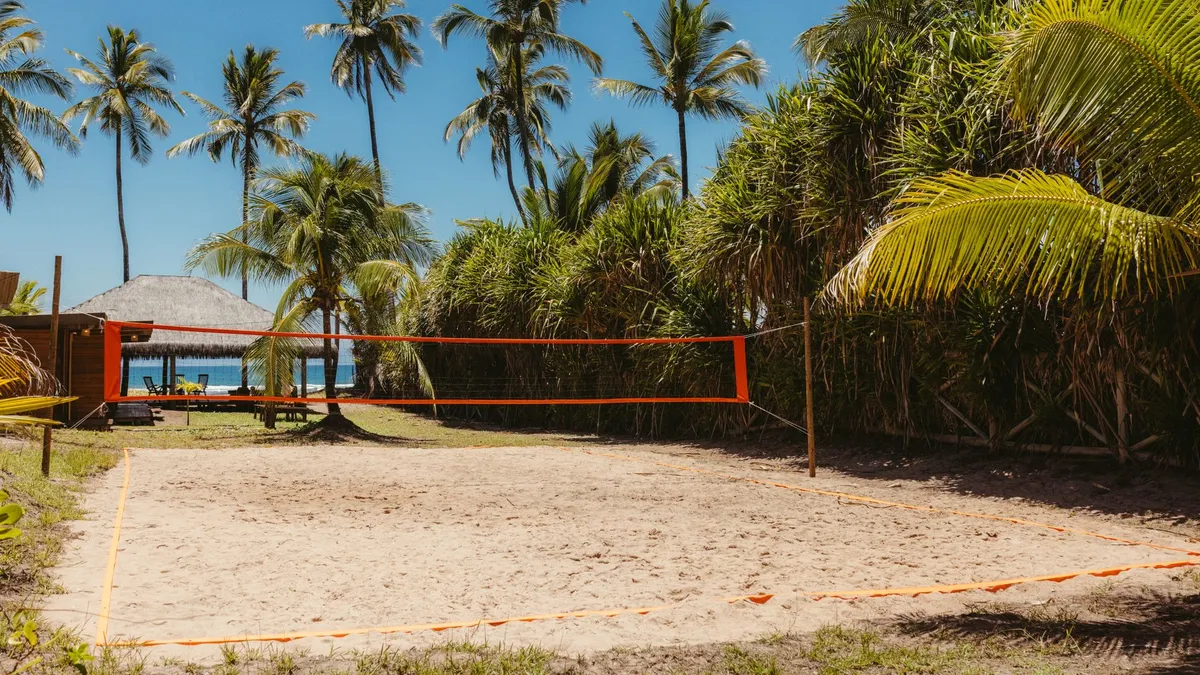
A beach volleyball court measures 16 × 8 m. In official competitions the sand is at least 40 cm deep and the net is 2.43 m high for men and 2.24 m for women. The figures come from the FIVB Official Beach Volleyball Rules 2025–2028.
How big is a beach volleyball court?
The size of a beach volleyball court is set out in the "Playing Area" section of the FIVB Official Beach Volleyball Rules 2025–2028, published by the International Volleyball Federation (FIVB). The playing court is a rectangle measuring 16 × 8 m, surrounded by a free zone at least 3 m wide on all sides. The free playing space above must be clear of obstructions to a height of at least 7 m. For FIVB, World and Official Competitions the free zone is a minimum of 5 m and a maximum of 6 m from the end lines and side lines, and the free playing space is at least 12.5 m high. Unlike indoor volleyball, there is no centre line.
| Dimension | Value |
|---|---|
| Playing court | 16 × 8 m |
| Free zone (general) | At least 3 m on all sides |
| Free zone (FIVB/Official) | 5–6 m |
| Sand depth (FIVB/Official) | At least 40 cm |
| Line width | 5 cm |
| Net height | Men 2.43 m, women 2.24 m |
| Net length and width | 8.5 m × 1 m |
| Post height | 2.55 m |
| Post distance from side line | 0.70–1.00 m |
| Service zone width | 8 m |
The sand surface and its depth
Under the Rules the surface must be composed of levelled sand, as flat and uniform as possible, free of rocks, shells and anything else that could cut or injure the players. For FIVB, World and Official Competitions the sand must be at least 40 cm deep and composed of fine loosely compacted grains; it should also be sifted to an acceptable size, not too coarse and not so fine that it causes dust and sticks to the skin. For the 16 × 8 m playing court alone, that depth means 128 × 0.40 = 51.2 m³ of sand. A tarp to cover the central court is also recommended in case of rain.
Lines
All lines are 5 cm wide and must be of a colour that contrasts sharply with the sand. The court is marked by two side lines and two end lines; there is no centre line. The lines are placed inside the dimensions of the playing court. The Rules call for ribbons made of a resistant material, with any exposed anchors made of a soft, flexible material. The service zone is an 8 m wide area behind the end line, extending to the edge of the free zone.
Net, antennae and posts
The net is placed vertically over the middle of the court, with its top at 2.43 m for men and 2.24 m for women. For age groups the height may vary: 2.24 m for 16 and under, 2.12 m for 14 and under and 2.00 m for 12 and under. It is measured from the centre of the court; the height over the two side lines must be the same and must not exceed the official height by more than 2 cm. The net is 8.5 m long and 1 m wide with 10 cm square mesh; for FIVB, World and Official Competitions an 8.0 m net with smaller meshes may be used. The side bands are 5 cm wide and 1 m long, and the antennae are 1.80 m long and 10 mm in diameter. The posts are 2.55 m high, placed 0.70–1.00 m outside the side lines and padded; for FIVB, World and Official Competitions the distance is 1 m.
Setting the dimensions out on site
The FIVB court inspection checklist recommends checking the accuracy of the lines with the diagonals: on a 16 × 8 m court the short diagonals are 11.31 m and the long diagonals 17.89 m. If these are equal, the court is rectangular. Checking every line and diagonal from a common reference point is far more reliable than correcting lines one by one. For the fall of the site and how water is dealt with, see falls and drainage on outdoor courts, and for the indoor court compare volleyball court dimensions. If the area is shared with other sports, read lines on multi-sport courts; for our hard-surface volleyball courts see acrylic volleyball court.
Frequently Asked Questions
How big is a beach volleyball court?
Under the FIVB rules the playing court is 16 × 8 m, with a free zone of at least 3 m around it, and 5–6 m in FIVB, World and Official Competitions.
How deep should the sand be?
For FIVB, World and Official Competitions the sand must be at least 40 cm deep, composed of fine loosely compacted grains and free of stones and shells.
How high is a beach volleyball net?
It is 2.43 m for men and 2.24 m for women; 2.24 m for 16 and under, 2.12 m for 14 and under and 2.00 m for 12 and under. It is measured from the centre of the court.
Is there a centre line on a beach volleyball court?
No. The court is marked only by two side lines and two end lines, and all lines are 5 cm wide.
Would you like a site survey for your floor? HBK Epoxy Flooring, based in Gaziantep, offers free surveys and quotations in the surrounding provinces.
0507 597 9537 WhatsAppRelated articles
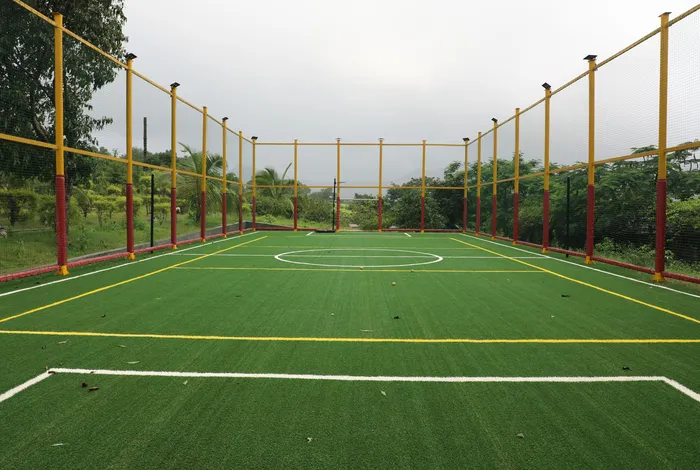
Small-Sided Pitch Sizes: How Big Is a 6+1 or 7+1 Pitch?
The Laws of the Game define no size for 6+1 and 7+1 small-sided pitches. For seven-a-side teams the English FA recommendation of about 55 × 37 m, and for eight-a-side teams the 70 × 50 m used in TFF Istanbul’s U11 league, can serve as references.
Read article ›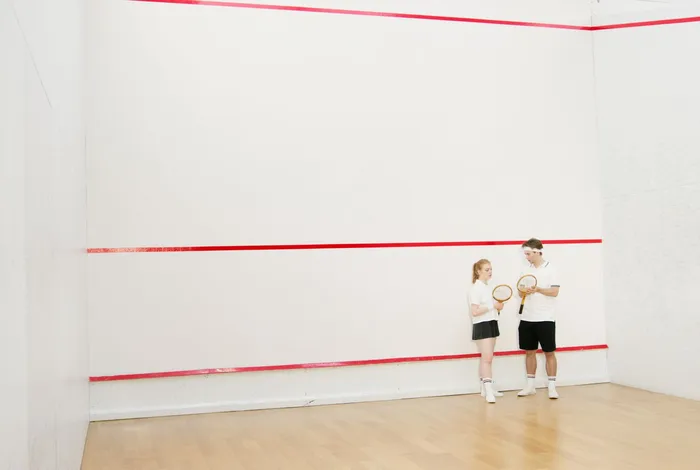
Squash Court Dimensions: Wall Lines and Floor
An international singles squash court is 9.75 m long and 6.40 m wide. The front wall line is at 4.57 m, the service line at 1.78 m and the back wall line at 2.13 m; the top of the tin is 48 cm above the floor.
Read article ›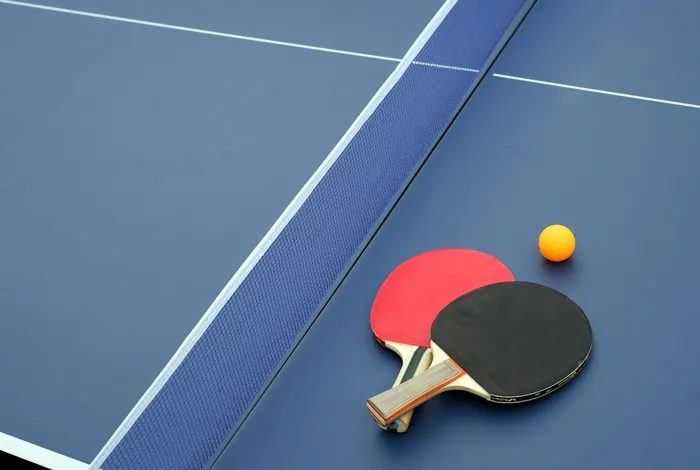
Table Tennis Table Dimensions: Height, Net and Playing Surface
A table tennis table has a playing surface 2.74 m long and 1.525 m wide, 76 cm above the floor. The net stands 15.25 cm above the playing surface. The figures are in chapter 2 of the ITTF Laws.
Read article ›