

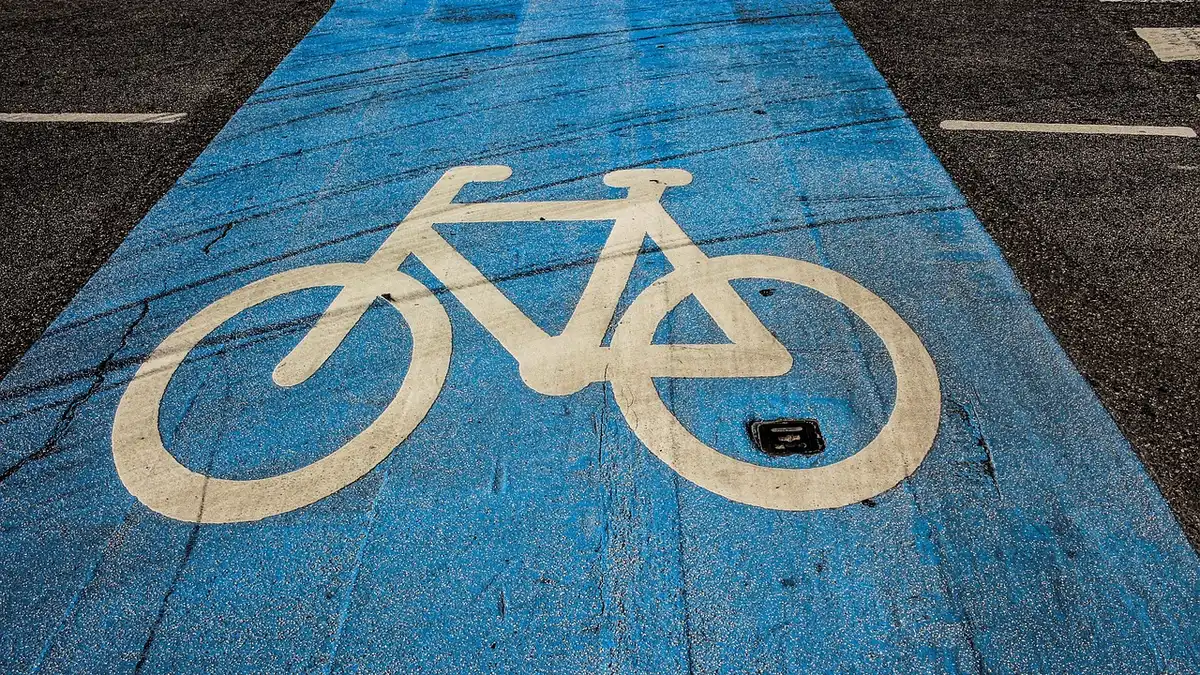
In the figures of Turkey's Bicycle Paths Regulation a one-way cycle lane and a separated cycle path are 130 cm wide, and a two-way rural cycle band is 230 cm. Junction crossings are painted in non-slip blue; if the rest of the path is painted, the colour is again blue.
How wide should a bike lane be?
In Turkey, cycle paths are planned, designed and built under the Bicycle Paths Regulation published in the Official Gazette on 12 December 2019. The regulation defines types including shared cycle routes, cycle lanes, separated cycle paths, cycle tracks in parks, rural cycle trails, rural cycle bands and cycle highways. Most widths are given in centimetres in the figures of Annex 1, which state that the widths shown are minimums. On that basis a one-way cycle lane on the right of the carriageway is 130 cm wide and is separated from traffic by a continuous white line 25 cm wide. A one-way cycle path physically separated from the carriageway is also 130 cm in total: a 20 cm line on each side with 90 cm of riding space between them.
| Type of cycle route | Minimum width |
|---|---|
| Cycle lane (one-way) | 130 cm + 25 cm separating line |
| Separated cycle path (one-way) | 130 cm (20 + 90 + 20 cm) |
| Rural cycle band (two-way) | 230 cm |
| Cycle bridge or tunnel (one-way) | 250 cm |
| Cycle bridge or tunnel (two-way) | 400 cm |
| Cycle track in parks | 90 cm (70 cm on side tracks of up to 50 m) |
| Rural cycle trail | 70 cm |
Safety distance from traffic
Where a separated cycle path runs next to the carriageway, a safety distance is added to the width of the path, and it grows with the speed limit of the road. On a road with a 50 km/h limit for cars, if the cycle path is at carriageway level at least 75 cm is left from the rightmost lane line; this strip is painted with 20 cm wide lines at 45° every 1 m, and 110 cm high delineators are placed down its centre every 1 m. Alternatively, a kerbed island at least 60 cm wide and 10 cm high can be built. On a 70 km/h road these values become a 120 cm painted strip or a 100 cm island or green strip, and on roads above 70 km/h a 175 cm painted strip or a 150 cm island or green strip. On 50 km/h sections with roadside parking the distances rise to at least 100 cm. The cycle path width shown in the zoning plan may not be less than the sum of the minimum path width and these safety distances.
Two-way paths, bridges and tunnels
The regulation plans cycle paths on the right of the carriageway, either in the same direction as traffic or two-way; on a two-way path the lane next to the pavement runs in the same direction as the traffic. A rural cycle band, built between settlements where there is no zoning plan, has one lane in each direction: the total width in the figure is 230 cm, a dashed white line 1 m long and 10 cm wide is painted every 3 m between the lanes, and the band may not come closer than 150 cm to the carriageway. Bridges and tunnels used only by cyclists are at least 250 cm wide if one-way and at least 4 m wide if two-way; 150 cm is added for each extra lane, with 50 cm left clear on each side. No obstruction is allowed up to a height of 3 m above the cycle path surface.
Coloured surfacing: which colour, and where is it required?
Under the regulation, the sections of cycle paths that cross carriageway junctions are painted with durable, non-slip blue paint, and dashed white lines measuring 50 × 50 cm are marked on both sides of the path in these sections. Painting is not required elsewhere, but if the local authority decides to paint the path, blue is used there too. A cycle path at carriageway level is separated by a dashed line at junctions and at garage or garden entrances, and the section between the dashed lines is painted with wear-resistant blue paint. In the regulation's own words, the two qualities required of the paint are durability and slip resistance; we explain how slip resistance is measured on wet surfaces in slip resistance ratings.
Surface material, gradient and drainage
Except for rural cycle trails, the top layer of a cycle path should be asphalt or concrete; the authority may use a material with similar properties provided it gives a safe riding surface. Cycle tracks in parks use a permeable surface material, and cycle highways use asphalt. The longitudinal gradient should not exceed 5%, and signs are placed where it does. On a cycle path built above carriageway level the cross-fall is 2% towards the carriageway. We discuss falls and drainage that stop water standing on open surfaces in falls and drainage on outdoor courts. For road and car park markings see our car park line marking page, and for bay sizes our article on parking space dimensions.
Frequently Asked Questions
How wide should a bike lane be?
According to the figures in Turkey's Bicycle Paths Regulation, a one-way cycle lane and a one-way separated cycle path are at least 130 cm wide, and a two-way rural cycle band at least 230 cm.
What colour should a bike lane be?
The regulation requires durable, non-slip blue paint where cycle paths cross carriageway junctions; if other sections are painted, blue is used there too.
How far should a bike lane be from traffic?
At carriageway level, at least 75 cm on a 50 km/h road, 120 cm at 70 km/h and 175 cm on faster roads; with an island or green strip the values are 60, 100 and 150 cm.
How wide is a two-way cycle path?
A rural cycle band is two-way and is 230 cm wide in total in the figure. Two-way bridges and tunnels used only by cyclists are at least 4 m wide.
Would you like a site survey for your floor? HBK Epoxy Flooring, based in Gaziantep, offers free surveys and quotations in the surrounding provinces.
0507 597 9537 WhatsAppRelated articles
Epoxy Coverage: How Many m² Does 20 kg of Epoxy Cover?
How far epoxy goes depends not on the weight of the kit but on the thickness of the layer and the density of the product; the calculation takes minutes.
Read article ›
Flooring Without Stopping Production: Planning a Phased Installation
Renewing a factory floor does not have to halt production for weeks. Dividing the area into phases and choosing fast-curing systems lets the work finish while operations continue.
Read article ›
10 Questions to Ask Before Accepting a Flooring Quote
Two quotes for the same square metres can differ widely, often because they do not describe the same job. The right questions make quotes truly comparable.
Read article ›