

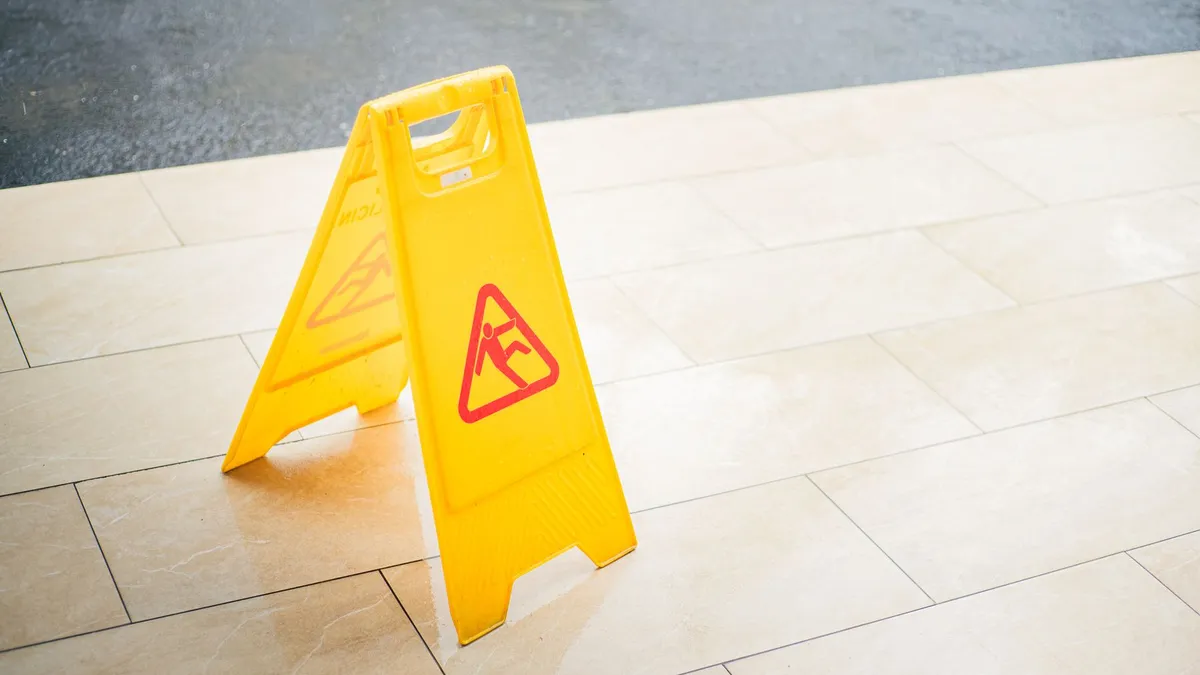
The R9, R10… R13 labels on data sheets show how well a floor grips on an incline. Higher numbers mean more grip; the class needed depends on how wet and oily the area is.
What is the R value?
R classes are based on the inclined-plane test developed in Germany as DIN 51130; today the method sits in Annex B of DIN EN 16165. A test person wearing shoes walks on an oiled sample while the incline is gradually increased, and the angle at which the limit of safe walking is reached is recorded.
The classes
From R9 to R13, grip increases as the class rises. R9 corresponds to dry indoor areas; higher classes to wet and oily areas. Manufacturers' tables give the angle bands approximately as follows: above 6° up to 10° for R9, 10–19° for R10, 19–27° for R11, 27–35° for R12 and above 35° for R13.
The test angle is not a ramp gradient
A common mix-up is to treat the test angle as the slope of the ramp where the floor will be laid. As manufacturers' data sheets point out, these angles serve only for classification: an R11 floor does not mean that a 19-degree ramp can be walked safely. The rules ask for a higher class on ramps in their own right, as explained below.
The V value: displacement space
Where slippery substances such as oil, food waste or mud keep landing on the floor, a rough surface alone is not enough; recesses are needed below the walking plane where these substances can collect. This volume is shown as V4, V6, V8 or V10, and the number gives the minimum volume in cubic centimetres per square decimetre. For instance, the table specifies R12 V6 for oil and grease stores from which partial quantities are drawn off.
By area type
Dry offices and corridors may need only lower classes; commercial kitchens, food production and oily workshops need higher ones. Two examples from the table in ASR A1.5, the German workplace rule for floors: indoor entrance areas into which moisture is carried from outside need R9, while outdoor entrances need R11 (or R10 V4). Kitchen values are covered in commercial kitchen flooring, and schools and hospitals in school and nursery floors and hospital and clinic flooring.
Ramps and stairs
According to the table, indoor stairs onto which moisture can be carried from outside need R9, and outdoor stairs need R11 (or R10 V4). Indoor ramps in the same situation take one class higher than the floor that leads to them. Outdoor ramps with a gradient of 3% or more call for R12 (or R11 V4). Issues specific to vehicle ramps are covered in anti-slip coatings for car park ramps.
Transitions between neighbouring areas
If two adjoining areas use different classes, the rule is that they should be neighbouring classes, for example R10 and R11 or R11 and R12. Where staff move back and forth between adjoining areas during the day, both areas are given the higher class.
Barefoot areas
Barefoot areas such as pool surrounds and showers use a separate test and classification (A, B, C). The test is carried out barefoot under Annex A of DIN EN 16165; according to the December 2025 edition of the DGUV 207-006 guide, above 12° up to 18° is class A, above 18° up to 24° is class B and above 24° is class C. Which zone needs which class is explained in pool deck surfaces.
Wall edges and cleaning
A textured surface reduces slipping but makes cleaning harder. The rules therefore allow some flexibility: in a strip of about 15 cm along walls, in corners and under machines fixed to the floor, a flat, unprofiled surface may be used to make cleaning easier. Rounded transitions between floor and wall are also noted as being easier to clean than right-angled ones.
Using ratings in selection
When choosing a coating system, the target class is set first; texture is adjusted to it and balanced with cleanability. The tables give minimum values, and work specific to a business may require a higher class or a larger displacement volume. Check which filler and top coat the class in the data sheet was measured on, and make the final decision on a sample (anti-slip epoxy, epoxy floor coating).
Frequently Asked Questions
What is the difference between R10 and R12?
Grip increases with class: R10 corresponds to about 10–19° in the test and R12 to 27–35°, intended for wetter and oilier areas.
How is the R class measured?
With the inclined-plane test: a person in shoes walks on an oiled sample, the incline is raised and the angle at which safe walking ends is measured. The method was formerly known as DIN 51130 and is now Annex B of DIN EN 16165.
Which classification is used around pools?
Barefoot areas use the A, B, C classification; C indicates the highest slip resistance.
What does V4 mean?
It shows that the recesses below the walking plane, where slippery substances can collect, provide at least 4 cm³ of volume per square decimetre.
Would you like a site survey for your floor? HBK Epoxy Flooring, based in Gaziantep, offers free surveys and quotations in the surrounding provinces.
0507 597 9537 WhatsAppRelated articles

Bike Lane Width and Coloured Surfacing: What Are the Rules?
In the figures of Turkey's Bicycle Paths Regulation a one-way cycle lane and a separated cycle path are 130 cm wide, and a two-way rural cycle band is 230 cm. Junction crossings are painted in non-slip blue; if the rest of the path is painted, the colour is again blue.
Read article ›
Epoxy Coverage: How Many m² Does 20 kg of Epoxy Cover?
How far epoxy goes depends not on the weight of the kit but on the thickness of the layer and the density of the product; the calculation takes minutes.
Read article ›
Flooring Without Stopping Production: Planning a Phased Installation
Renewing a factory floor does not have to halt production for weeks. Dividing the area into phases and choosing fast-curing systems lets the work finish while operations continue.
Read article ›