

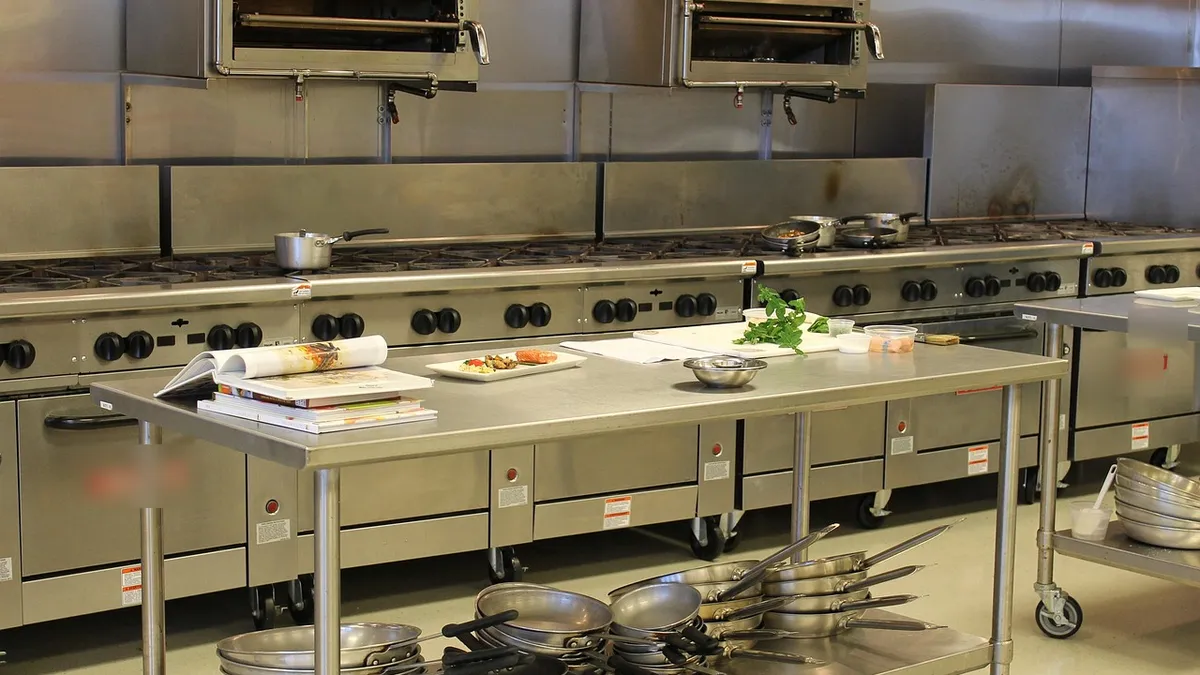
In a commercial kitchen the floor must cope with grease, water and hot washing at once, keep chefs on their feet and never trap dirt in joints.
Grease, water and heat
Professional kitchen floors meet grease, water, sauces and hot wash water all day. Tile grout absorbs this dirt and darkens over time, and cracked tiles create hygiene gaps. That is why seamless resin floors are increasingly chosen for commercial kitchens.
What the rules ask of the floor
Restaurant and catering kitchens are food businesses. Under Article 11 of Türkiye's Food Hygiene Regulation, floors in rooms where food is prepared must be sound, easy to clean and, where necessary, easy to disinfect; they must be made of impervious, non-absorbent, washable and non-toxic materials and, where appropriate, allow adequate surface drainage. A seamless coating meets these points directly.
Slip resistance is vital
Greasy, wet floors are a leading cause of kitchen accidents. Choose an anti-slip system with good texture that remains cleanable. German workplace floor rules (ASR A1.5/1,2 and DGUV Regel 108-003), for example, specify class R12 for dishwashing rooms. We explain what the classes mean in R9–R13 slip resistance ratings and how texture is chosen in anti-slip epoxy.
Hot washing and thermal shock
Areas in front of boilers and ovens, and zones washed with hot water, face thermal shock. Polyurethane-cement systems are often preferred here. The data sheets show why: in a sand-broadcast build of about 3–4 mm, the Sikafloor-264 epoxy system withstands continuous dry heat of +50 °C, but moist heat such as steam cleaning up to +80 °C only occasionally and for short periods. In the data sheet for the polyurethane-cement Ucrete UD 200, resistance rises with thickness: about +80 °C at 6 mm, +120 °C at 9 mm and +130 °C at 12 mm. More on our Ucrete flooring page.
Dividing the kitchen into zones
Not every corner of a kitchen carries the same load. The front of the fryer, boiler and pan line sees hot oil and thermal shock; the dish room constant water and hot washing; meat and vegetable preparation dropped knives, impact and acidic food; and the dry store mostly just traffic. Choosing a system and texture for each zone gives a better result than covering the whole kitchen with one uniform floor.
Drains and falls
Falls are kept so water reaches drains quickly, and the coating joins drain channels watertight. The coating is brought right up to the edge of the stainless steel drain body and bonded to it; even a hairline gap lets water get under the coating. We explain how water finds that path on our is epoxy flooring waterproof page.
Wall bases, equipment feet and transitions
Coved skirting at wall bases and continuous coating around the feet of counters and kettles stop dirt from collecting. The cold room door is a special point: the temperature difference between the room and the kitchen causes condensation and slipperiness, a transition we cover in cold storage flooring.
Degreasers and cleaning chemicals
The strong alkaline degreasers and disinfectants used in kitchens touch the floor every day. The system's resistance to them is checked by comparing the safety data sheets of the cleaning products with the manufacturer's resistance chart; the method is explained in how to read a chemical resistance chart.
Installing without closing
Closing a kitchen for long is difficult. Work can be planned around closed days or in sections. The cooking line can be done one weekend and the dish room the next, so the kitchen keeps working at partial capacity (phased installation). Because curing depends on temperature, the schedule follows the times in the data sheet.
Daily care
Spilled grease is removed without delay; the floor is washed with a suitable detergent, ideally by machine, and the water squeegeed to the drain. On a textured surface a brush scrubber lifts grease from between the grains better than a mop. Similar needs in food factories are covered in flooring for food production plants.
Frequently Asked Questions
Tiles or a coating in a commercial kitchen?
A seamless coating removes grout dirt and cracked-tile problems.
Does a kitchen floor withstand hot water?
It depends on the system. The example epoxy data sheet allows moist heat up to +80 °C only occasionally; polyurethane-cement systems suit areas with hot washing and thermal shock.
Can we install without closing the kitchen?
Work can be planned around closed days or in sections.
What slip resistance class does a commercial kitchen need?
It depends on how wet and greasy each zone is; German workplace rules, for example, specify R12 for dishwashing rooms. Texture is balanced against cleanability.
Would you like a site survey for your floor? HBK Epoxy Flooring, based in Gaziantep, offers free surveys and quotations in the surrounding provinces.
0507 597 9537 WhatsAppRelated articles

Parking Space Dimensions: Bay Sizes Under Turkey's Car Park Regulation
Turkey's Car Park Regulation sets a minimum of 2.40×4.90 metres for a car parking space and a minimum width of 3.50 metres for an accessible bay. Line layouts are planned with these sizes and the aisle.
Read article ›
Car Park Floor Coatings: Protection Against Salty Water and Slush in Winter
In winter, cars bring snow, slush and road de-icing salt into car parks. This salty water can penetrate concrete and reach the rebar; the right coating, falls and maintenance protect the deck.
Read article ›
Is Epoxy Flooring Suitable for Homes? Living Room, Kitchen and Bathroom
Epoxy can be used at home too, but a house brings different expectations from a factory. The substrate, grip in wet rooms and sunny windows decide the right choice.
Read article ›