

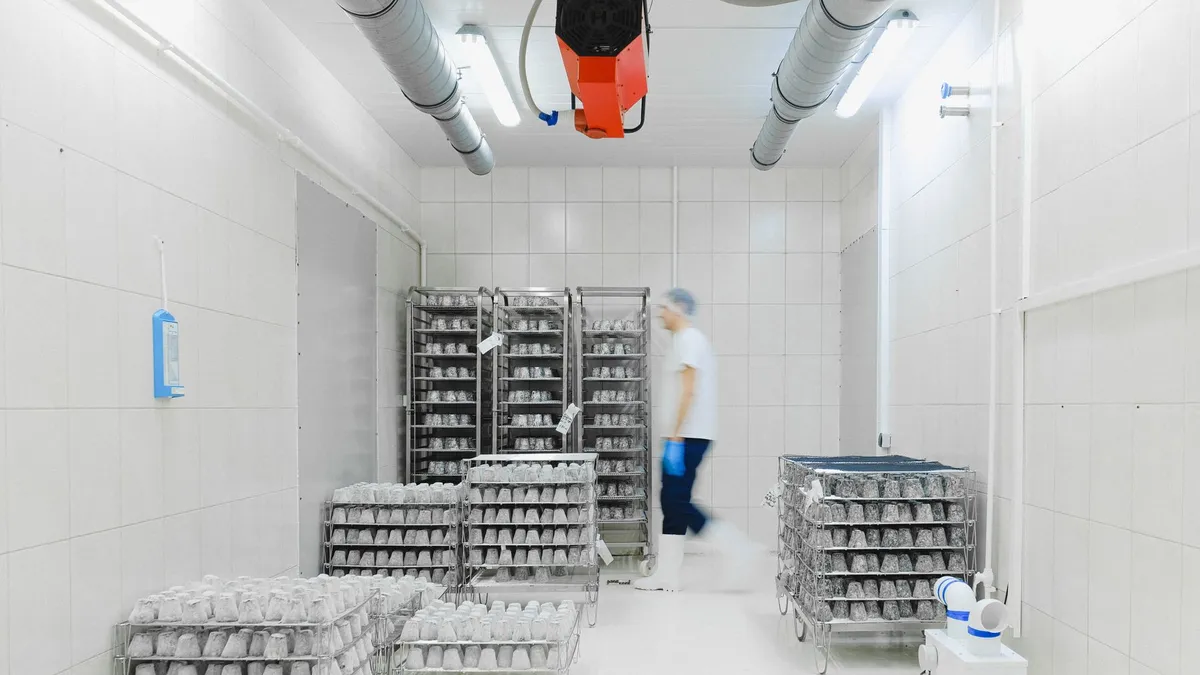
In cold storage the floor must not crack below zero, must cope with the temperature difference at the door and must stay grippy despite condensation.
Cold stresses materials
At low temperatures many coatings harden and become brittle. In cold rooms and blast freezers the floor needs a system that stays flexible and crack-free below zero. When choosing the system, not only the store temperature but also the sudden temperature change when the door opens and the cleaning water are taken into account.
The lower temperature limit in the data sheet
In polyurethane-cement systems, resistance to cold depends on thickness. Ucrete UD200 data sheets, for example, rate a floor of about 6 mm as suitable for freezer temperatures down to −25 °C, and floors of 9 and 12 mm down to −40 °C. Thickness is therefore chosen according to the lowest operating temperature of the store (Ucrete flooring).
The temperature difference at the door
When the door opens, warm and cold air meet, and the floor in this zone undergoes constant thermal change. Thermal-shock-resistant polyurethane-cement systems are often preferred here; we compare them with epoxy on our polyurethane vs epoxy page.
Freezing beneath the slab
In rooms kept permanently below zero, cold gradually passes into the ground under the slab even when there is insulation. According to Danfoss's application manual for cold stores, moisture in the soil expands as it freezes, and the slab cracks and rises, in other words it heaves. The manual states that this cannot be solved by insulation alone; it recommends heating cables placed below the main insulation and, for safety, two parallel systems as main and reserve.
A coating does not solve this
Frost heave is a structural problem; however good the coating on top, it cracks along with the heaving slab. In a new cold store, underfloor heating and insulation are therefore resolved in the design before the coating is chosen. If an existing store has a floor that keeps rising or cracking, that cause is investigated first (renovating damaged concrete floors).
Temperature limits for installation
Coatings cure within specific temperature ranges. The Ucrete UD200 data sheet requires an air and substrate temperature of at least +5 °C and a product temperature of at least +10 °C for application; we give the limits for epoxies in temperature and humidity. In a new store, the floor should be coated before refrigeration is switched on.
Renovating an operating store
In an operating store, the room is emptied and brought to the temperature the data sheet requires, and the work is planned section by section (phased installation). According to the same data sheet, the floor can return to traffic after about 16–24 hours at a substrate temperature of +8 °C, or after about 4 hours at +10 °C when an accelerator is used. These times are approximate and change with conditions.
Measuring and recording
The data sheet asks for substrate moisture, relative humidity, air and surface temperature and dew point to be measured before application, and for these values to be recorded at least every three hours during installation, or more often when conditions change. Because surface temperature changes quickly in cold stores, this record is especially important (dew point calculation).
Condensation and grip
Moisture condensing around doors makes the floor slippery. A slip-resistant finish in these zones is important for forklift and staff safety. The table in ASR A1.5, the German workplace rule, specifies R12 for unpackaged goods and R11 for packaged goods in cold rooms and deep-freeze stores (slip resistance ratings, anti-slip epoxy).
Forklift traffic
Cold stores see heavy forklift traffic; an abrasion-resistant system of adequate thickness ensures a long service life. Rack feet and narrow aisles add further loads to the floor; we cover these in racking and floor loads.
Hygiene in food stores
In cold stores holding food, the floor must also meet cleanability and hygiene expectations. For seamless surfaces, coved skirtings and drain details, see our article on food plant flooring. The Danfoss manual also points out that condensate can freeze in the drain lines of refrigeration equipment; protecting these lines is part of the floor plan.
Frequently Asked Questions
Is epoxy used in cold stores?
In low-temperature and thermal-shock areas, polyurethane-cement systems are usually more suitable; epoxy data sheets also require at least +10 °C for application.
Can an operating cold store be coated?
Yes; the room is emptied and brought to the temperature the data sheet requires, and the work proceeds section by section. Ideally, though, the floor is coated before refrigeration starts.
How is slipperiness at the door prevented?
With an anti-slip finish and correct door-area detailing; the ASR A1.5 table specifies R11 for packaged goods and R12 for unpackaged goods in cold rooms.
Does coating thickness affect cold resistance?
Yes; Ucrete UD200 data sheets, for example, rate a floor of about 6 mm as suitable down to −25 °C and floors of 9 and 12 mm down to −40 °C.
Would you like a site survey for your floor? HBK Epoxy Flooring, based in Gaziantep, offers free surveys and quotations in the surrounding provinces.
0507 597 9537 WhatsAppRelated articles

Parking Space Dimensions: Bay Sizes Under Turkey's Car Park Regulation
Turkey's Car Park Regulation sets a minimum of 2.40×4.90 metres for a car parking space and a minimum width of 3.50 metres for an accessible bay. Line layouts are planned with these sizes and the aisle.
Read article ›
Car Park Floor Coatings: Protection Against Salty Water and Slush in Winter
In winter, cars bring snow, slush and road de-icing salt into car parks. This salty water can penetrate concrete and reach the rebar; the right coating, falls and maintenance protect the deck.
Read article ›
Is Epoxy Flooring Suitable for Homes? Living Room, Kitchen and Bathroom
Epoxy can be used at home too, but a house brings different expectations from a factory. The substrate, grip in wet rooms and sunny windows decide the right choice.
Read article ›