

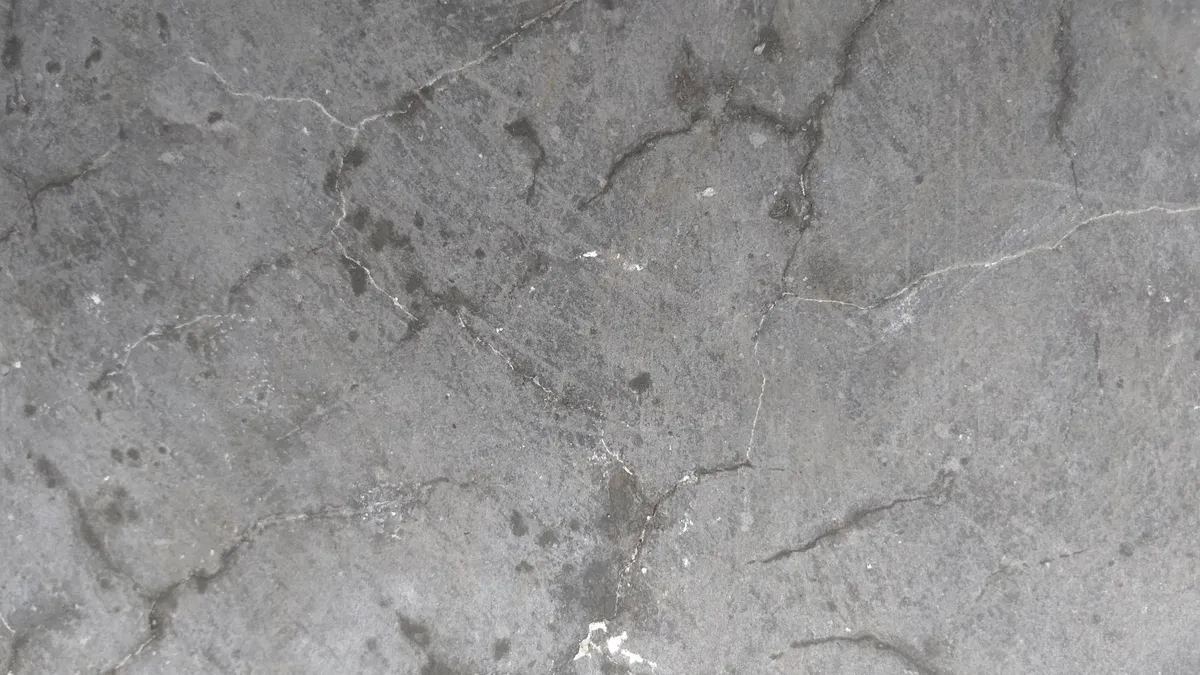
To bring a pitted, broken or worn slab back into use, first understand the damage. Surface damage can be repaired and coated; structural damage needs an expert assessment first.
Understanding the damage
Surface wear, spalled joint edges, potholes and hairline cracks are usually superficial. Settlement and wide, growing cracks can signal a structural problem. This distinction decides whether the job is repair and coating or structural engineering first; damage that is misdiagnosed simply comes back through the new coating.
Structural damage: expert first
After earthquakes, ground settlement or overloading, get a structural engineer's assessment before coating. A coating does not fix a structural problem; it only covers it. If the engineer decides that the slab must be strengthened or that part of it must be recast, the floor coating is planned after that work.
Mapping the damage
During the survey, damaged zones are marked on a plan and photographed: broken joint edges, potholes, hollow-sounding areas, oil and damp stains. The approximate area and depth of each zone are noted. The map shows the amount of repair before work starts and lets quotes be compared on the same scope. When the work is finished, the same plan is kept as a record of which zones were repaired and how.
Removing weak concrete
The surface a repair bonds to must be sound. The Sikafloor-161 data sheet asks for weak concrete to be removed, blowholes and voids to be fully exposed, and laitance to be taken off with abrasive equipment to achieve an open-textured surface. This is usually done by grinding or planing (concrete grinding).
Repairing surface damage
Loose concrete is broken out and cleaned, and holes and broken edges are filled with resin or cement-based repair mortars. The edges of each patch are cut straight and sound; feathered edges break away easily under traffic. Dust and loose particles are removed with a brush or vacuum immediately before application.
Repairing with resin mortar
For deep potholes and broken strips, resin mortar is a fast and durable solution. The Sikafloor-161 data sheet describes an epoxy repair mortar of about 15–20 mm as follows: primer, then a bonding bridge; the mortar is spread while the bridge is still tacky, then compacted and smoothed with a trowel or power float. A practical trial is carried out first to confirm the sand blend (epoxy mortar).
Classes of cementitious repair mortar
Cement-based repair mortars are classified from R1 to R4 under EN 1504-3. For example, one manufacturer's declaration of performance for a class R4 mortar states a compressive strength of at least 45 MPa and an adhesive bond of at least 2.0 MPa. When choosing a product, the class is considered together with the depth of the repair and the load it will carry.
The mortar before coating
Cement-based mortar contains water, so moisture is measured before a resin coating goes on top (concrete moisture testing). The type of mortar matters too: the Ucrete data sheet says not to apply over polymer-modified cement mortars that may expand when sealed with an impervious resin. For this reason the repair mortar is chosen together with the system that goes over it.
Cracks and joints
On damaged floors, cracks and broken joints usually appear together. A crack that has stopped moving is repaired differently from one that is still working, and joints keep their place in the coating. We explain this distinction and the filling methods in joint and crack repair.
Levelling
Level differences between repaired patches and the existing floor are removed with levelling layers so the coating sits on an even base. The thickness of the levelling coat and the waiting times between coats follow the data sheet of the product used. On large, uneven areas a self-smoothing layer improves both flatness and appearance (self-levelling system).
A new coating
Once repairs and preparation are done, a system suited to the use is applied, and a tired old floor serves the facility again. In operating facilities, repair and coating can be carried out section by section (phased installation). For system options, see our epoxy floor coating page.
Frequently Asked Questions
Can a broken concrete floor be coated?
Yes, once surface damage has been repaired and the weak surface removed; structural damage needs an engineer's assessment first.
What about structural cracks?
Get a structural engineer's assessment before coating; a coating does not fix a structural problem, it only covers it.
How are potholes repaired?
Loose material is broken out and cleaned, the edges are cut straight, and the hole is filled with resin or cement-based repair mortar and brought level with its surroundings.
When can a repair mortar be coated?
With cement-based mortar, moisture is measured before coating and the waiting time in the product data sheet is observed; with resin mortar, the overcoating times in the data sheet apply.
Would you like a site survey for your floor? HBK Epoxy Flooring, based in Gaziantep, offers free surveys and quotations in the surrounding provinces.
0507 597 9537 WhatsAppRelated articles

Bike Lane Width and Coloured Surfacing: What Are the Rules?
In the figures of Turkey's Bicycle Paths Regulation a one-way cycle lane and a separated cycle path are 130 cm wide, and a two-way rural cycle band is 230 cm. Junction crossings are painted in non-slip blue; if the rest of the path is painted, the colour is again blue.
Read article ›
Epoxy Coverage: How Many m² Does 20 kg of Epoxy Cover?
How far epoxy goes depends not on the weight of the kit but on the thickness of the layer and the density of the product; the calculation takes minutes.
Read article ›
Flooring Without Stopping Production: Planning a Phased Installation
Renewing a factory floor does not have to halt production for weeks. Dividing the area into phases and choosing fast-curing systems lets the work finish while operations continue.
Read article ›