

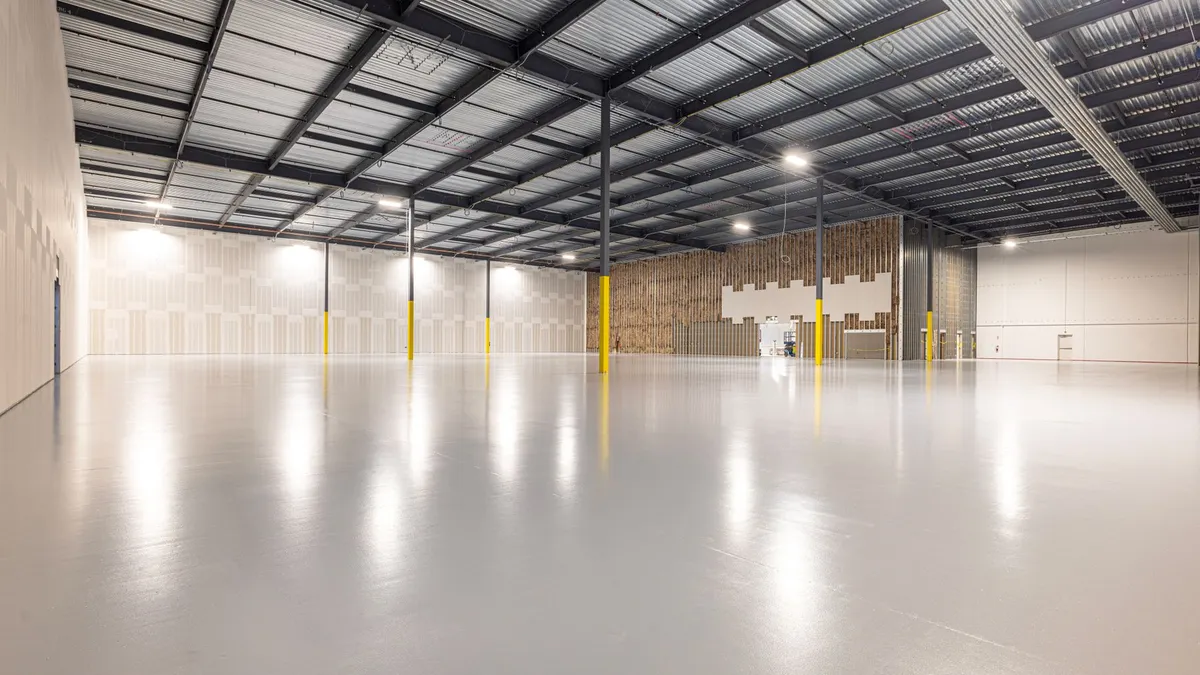
A dusting concrete floor dirties products and machinery. Surface hardeners strengthen the top of the slab, reducing dust and improving abrasion resistance.
Why concrete dusts
If the top of the slab is weak, traffic and friction break off fine particles. This dust spreads onto racks, products and machinery.
Dry-shake hardeners for fresh concrete
Mineral or metallic aggregate hardeners broadcast onto fresh concrete and worked in by trowelling form an abrasion-resistant top layer. They are applied together with power floating.
Liquid hardeners for existing slabs
On existing floors, liquid hardeners soak into the concrete and react with it, densifying the surface and reducing dust.
How they differ from coatings
A hardener strengthens the concrete itself; colour and chemical resistance need a coating. They answer different needs.
Where they are used
In warehouses, logistics centres, production areas and car parks with heavy traffic and no colour requirement.
Frequently Asked Questions
How is a dusting concrete floor fixed?
With a liquid hardener, a sealer or a coating, chosen by the conditions of use.
When is a dry-shake hardener applied?
While the concrete is being placed, together with trowelling.
Can a hardener replace a coating?
It strengthens the concrete, but colour and chemical resistance need a coating.
Would you like a site survey for your floor? HBK Epoxy Flooring, based in Gaziantep, offers free surveys and quotations in the surrounding provinces.
0507 597 9537 WhatsAppRelated articles

Choosing Stamped Concrete Patterns and Colours
Two things define how stamped concrete looks: the stamp pattern and the colour. The right choice depends on use, architecture and surrounding materials.
Read article ›
Penetrating Sealers: Protecting Concrete Without a Coating
Not every concrete floor needs a coating. Penetrating sealers soak into the concrete and protect it from dust, water and stains without changing its natural look.
Read article ›
Saw-Cutting Joints in New Concrete Floors: Timing and Spacing
As concrete dries and shrinks it wants to crack somewhere. Joints cut at the right time and spacing make that crack form along a straight line instead of at random.
Read article ›