

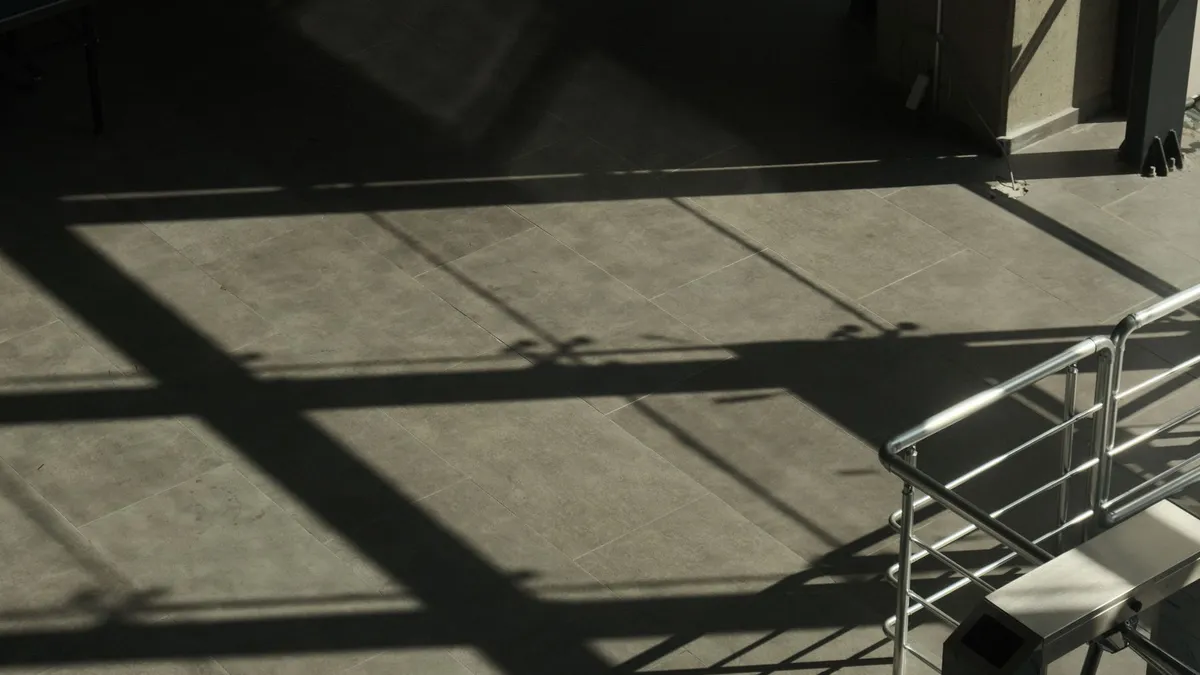
Not every concrete floor needs a coating. Penetrating sealers soak into the concrete and protect it from dust, water and stains without changing its natural look.
How they differ from coatings
Coatings form a film on top of the concrete. Penetrating sealers soak into its pores and leave no noticeable layer on the surface. Sealed concrete therefore keeps breathing, and its surface stays close to the look of natural concrete.
Three types in the standard
For concrete surface protection products, EN 1504-2 defines three types: hydrophobic impregnation, impregnation and coating. A hydrophobic impregnation makes the inner walls of the pores water-repellent without filling them; an impregnation partly or fully fills the pores; a coating forms a continuous layer on the surface. The quote and the data sheet should state clearly which type is proposed.
Silane-based water repellents
Silane-based products are a common example of hydrophobic impregnation. The Sikagard-706 Thixo data sheet, for instance, describes it as a one-component, solvent-free silane cream with about 80% active substance. According to the data sheet it forms no film, does not noticeably change water vapour permeability and also reduces the absorption of salts dissolved in water.
What they do
They reduce water absorption, delay staining and make cleaning easier, while the concrete largely keeps its natural look. The silane data sheet also states that the concrete's resistance to freeze-thaw cycles and de-icing salts increases. This matters for open car parks and ramps (car park ramps).
Penetration depth
A hydrophobic impregnation works only as deep as it penetrates. EN 1504-2 divides penetration depth into classes, and the Sikagard-706 Thixo data sheet gives class II, which means at least about 10 mm. The data sheet notes that this was measured on test concrete with a water/cement ratio of 0.70; in denser concrete the depth may differ.
Consumption and a trial area
The data sheet gives consumption of about 200–300 g/m² per coat, depending on the profile and porosity of the surface and the penetration depth required; one coat is usually enough. The same data sheet asks for a small trial area first, to confirm consumption and penetration depth.
Application conditions
According to the data sheet, air temperature should be between +5 and +40 °C and substrate temperature between +5 and +35 °C, with surface moisture below about 5–6% by the Tramex method (concrete moisture testing). The treated surface is protected from rain for at least 3 hours at +20 °C. Best results come on 28-day-old concrete, though the product's alkali resistance also allows earlier application.
Darkening and nearby surfaces
Silane can darken concrete, so the data sheet recommends applying a sample area first. Surfaces that must not be treated, such as window glass and frames still to be painted, are covered. Because the product can damage some coatings and bituminous materials, nearby waterproofing and paintwork are protected as well.
If it will be painted over
A silane impregnation is also used as a water-repellent primer under some protective coatings. The data sheet states that water- and solvent-based polymer paints can be applied after at least 5 hours and at most one week, while limewash and cement-based paint cannot be applied over it. The paint manufacturer's advice is also obtained.
Where they are used
In architectural spaces that want a natural concrete look, open car parks, outdoor walkways and decorative surfaces such as stamped concrete. They are also considered for protecting polished concrete (concrete polishing, stamped concrete).
Limits
Sealers do not protect against heavy chemical attack or intense abrasion as well as coatings. In such areas epoxy or polyurethane systems are better. To strengthen a weak, dusting surface, hardeners are used instead (concrete surface hardener).
Reapplication
Sealers lose effect over time; a water-beading test shows when to reapply. If water poured on the surface no longer beads but soaks in quickly and darkens the concrete, protection has faded. We describe a similar test for sealed surfaces in stamped concrete resealing.
Frequently Asked Questions
What is the difference between a sealer and a coating?
A coating forms a surface film; a penetrating sealer soaks into the pores and leaves no noticeable layer.
Does a sealer change the concrete's look?
It largely keeps the natural look, but silane products can darken concrete slightly, so a sample area is applied first.
When is a sealer reapplied?
When a water-beading test shows that water soaks in instead of beading, meaning its effect has faded.
Can a silane impregnation be painted over?
According to the example data sheet, water- and solvent-based polymer paints can be applied after at least 5 hours and at most one week; limewash and cement-based paint cannot. The paint manufacturer's advice is also obtained.
Would you like a site survey for your floor? HBK Epoxy Flooring, based in Gaziantep, offers free surveys and quotations in the surrounding provinces.
0507 597 9537 WhatsAppRelated articles
Screed vs Concrete: What Is the Difference and Where Is Each Used?
Concrete is a load-bearing building material; screed is a layer that levels the surface that will receive a floor finish. Their mixes, their roles and the checks needed before coating are different.
Read article ›
Pouring Concrete in Cold Weather: What Temperature, and How to Protect It
Concrete can be poured in winter; what matters is not the air but the temperature of the concrete and keeping it from freezing until it gains strength. TS 1248 sets the rules.
Read article ›
Choosing Stamped Concrete Patterns and Colours
Two things define how stamped concrete looks: the stamp pattern and the colour. The right choice depends on use, architecture and surrounding materials.
Read article ›