


Concrete can look dry yet hold moisture inside. Under a coating this moisture creates vapour pressure; work started without testing may later blister.
Looks can deceive
A newly poured slab or one resting on the ground can hold moisture inside even when its surface looks dry. Over time this moisture moves towards the surface. The top few millimetres of concrete dry quickly in wind and dry air, so a check that looks only at the surface can mislead.
What moisture does to a coating
A sealed coating traps moisture; vapour pressure underneath can weaken adhesion and show up as blisters, lifting or whitening. This blistering of resin coatings on damp substrates is also called osmotic blistering. The problem often appears weeks or months after application.
Quick readings at the surface
Surface moisture meters give a quick indication and help choose the points for detailed testing. Coating data sheets usually give moisture as a percentage by weight, together with the test method. The Sikafloor-32 Pronto data sheet, for example, sets the limit at 4% by weight and lists the Tramex meter, the carbide (CM) method or oven drying for measurement. Air humidity and dew point are a separate measurement (temperature and humidity).
The plastic sheet test
The same data sheet also requires no rising moisture and refers to the ASTM polyethylene sheet test for this. In this simple test a clear sheet is taped down at its edges on the surface; if condensation appears under the sheet or the concrete darkens after a while, rising moisture is suspected. The test does not replace measurement, but it gives an early warning.
Measuring inside the concrete
More reliable results come from methods that measure relative humidity inside the concrete. In ASTM F2170, widely used in the United States, a humidity probe is placed in a hole drilled into the slab. Under the standard, the hole depth is 40% of the slab thickness for a slab drying from one side and 20% for one drying from both sides; in a ground-bearing slab about 15 cm thick, for example, about 6 cm.
Waiting and calibration
ASTM F2170 requires 24 hours for moisture equilibrium within the hole before official readings are taken. Probe accuracy is also checked within 30 days before use, with a salt solution or a humidity chamber. Readings after a few hours give an idea, but the value for the record is taken following the standard's waiting time.
Where, and how many points?
Several points should be tested, as moisture is rarely spread evenly across an area. Door thresholds, the base of external walls, old water stains, areas around drains and shaded sections are measured separately. Test locations are marked on a sketch and recorded with the date, air temperature and humidity. We explain the place of these records in the warranty file in flooring warranty.
If moisture is high
Options are to wait for the slab to dry, or to use moisture-tolerant primers or moisture barrier systems. The choice depends on the results and the schedule. Concrete poured in winter dries more slowly; we explain why in pouring concrete in cold weather.
A temporary moisture barrier
Epoxy-cement mortars are used for this. The Sikafloor-81 EpoCem data sheet, for example, describes the product as a temporary moisture barrier that allows epoxy, polyurethane and PMMA floors to be applied to substrates with high moisture content or to green concrete. According to the data sheet the layer is at least 2 mm thick, impervious to liquids but permeable to water vapour, and can be overcoated with resin after 24 hours.
Ground-bearing slabs
Slabs without a damp-proof membrane can receive continuous moisture from the ground, which makes system choice even more important. Some coating data sheets state plainly that the product must not be used on substrates with rising moisture. Waiting does not solve this; a moisture-tolerant system or a moisture barrier is needed (do epoxy floors let water through).
Part of preparation
Moisture testing is one of the first steps of surface preparation, and its result can change the choice of system. We list the other steps in our preparation checklist before epoxy, and suggest asking whether testing is in the quote in 10 questions to ask before a quote.
Frequently Asked Questions
How long must concrete dry?
It depends on thickness, weather and ventilation; decide by measurement using the method in the data sheet, not by estimate.
What if coating is applied without testing?
If moisture is high, pressure builds under the coating and blistering or lifting can follow.
Can damp concrete never be coated?
It can, under suitable conditions, with moisture-tolerant primers or systems such as an epoxy-cement temporary moisture barrier.
At what depth is concrete moisture measured?
Under ASTM F2170 the probe hole is drilled to 40% of the slab thickness for a slab drying from one side and 20% for one drying from both sides, and the reading is taken after 24 hours of equilibrium.
Would you like a site survey for your floor? HBK Epoxy Flooring, based in Gaziantep, offers free surveys and quotations in the surrounding provinces.
0507 597 9537 WhatsAppRelated articles

What Is an Epoxy Primer? Why It Is Used and How It Is Applied
The primer is the first coat that bonds an epoxy coating to concrete. It seals the pores, binds fine surface dust and helps the following coats sit on a sound base.
Read article ›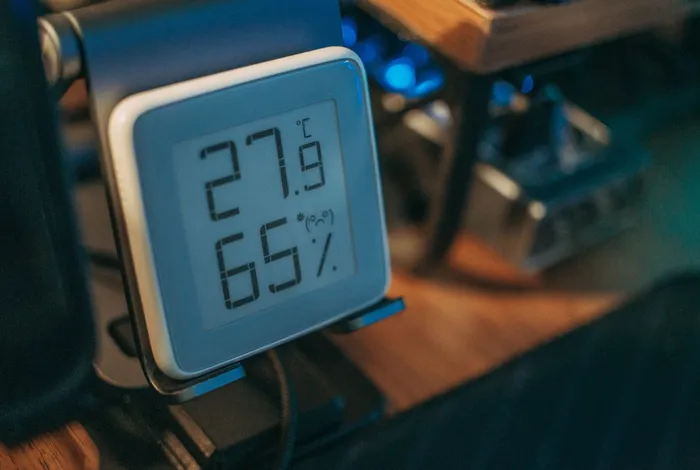
How to Calculate the Dew Point: The 3 °C Rule for Floor Coatings
If the floor temperature approaches the dew point, an invisible film of water forms on the new coating. Measuring temperature and humidity tells you the risk in minutes.
Read article ›
Stains and Scratches on Epoxy Floors: Prevention, Cleaning and Renewal
Epoxy is tough but not scratch-proof. Most stains come out with correct cleaning; deep scratches are removed with a topcoat renewal without removing the floor.
Read article ›