

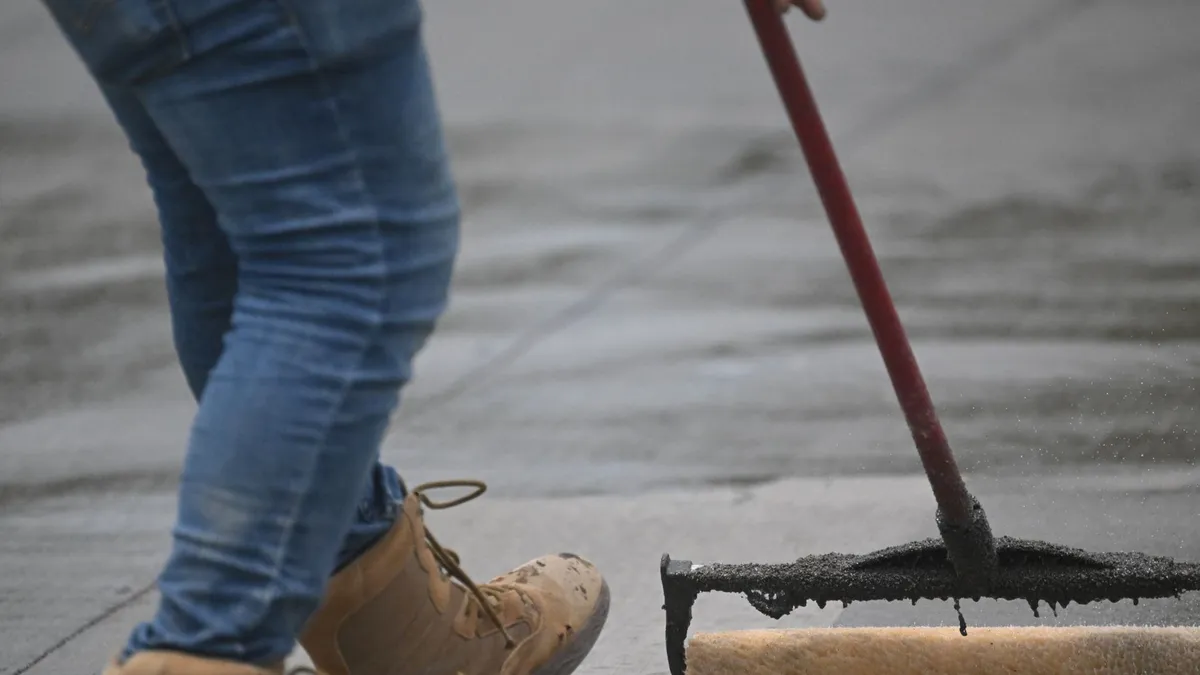
The primer is the first coat that bonds an epoxy coating to concrete. It seals the pores, binds fine surface dust and helps the following coats sit on a sound base.
Why is a primer needed?
Concrete is a porous surface that holds dust. A thick epoxy coat applied directly to it cannot fully penetrate the pores, and fine dust and a weak surface layer also reduce adhesion. An epoxy primer is a free-flowing first coat that soaks into the concrete: it enters the pores, binds fine surface dust and creates a sound base for the following coats to bond to.
The primer's second job is to limit air from inside the concrete rising into the upper coats. As temperatures rise, air in the concrete can expand and come to the surface, leaving small pinholes in the coating. A primer that seals the pores beforehand reduces this risk; we explain the role of temperature in our article on temperature and humidity when applying epoxy.
Surface preparation before priming
A primer only works on a prepared surface. The weak laitance layer, old paint and oil stains are removed by grinding or scarifying, and dust is taken up with an industrial vacuum. Which cracks and joints will be filled is decided in advance (joints and cracks before coating). The moisture of the concrete is also measured before priming, as a primer applied to damp concrete may not bond well (concrete moisture testing). If the substrate is a cementitious screed rather than concrete, we explain the difference in our article on screed vs concrete.
Application steps
- The two components (resin and hardener) are mixed in the ratio given in the product data sheet with a low-speed mixer until uniform.
- The mix is poured onto the floor and spread thinly and evenly with a roller or rubber squeegee; no puddles are left in hollows.
- On very absorbent concrete the primer soaks in quickly and the surface stays matt; in that case a second coat of primer may be needed.
- If a mortar or thick coat will follow, and the data sheet allows it, fine quartz sand is broadcast onto the fresh primer to create a rough surface.
- The next coat is applied within the waiting time given in the data sheet.
How much primer is needed?
Consumption depends on how absorbent the concrete is. For example, the Sikafloor-161 data sheet gives 0.35–0.55 kg/m² per coat of primer; on dusting or very absorbent old concrete the upper end of this range is approached. You will find a worked example for a 120 m² floor in our article on epoxy coverage.
Recoat time and winter conditions
The next coat over the primer should be applied neither too early nor too late. According to the same data sheet, a solvent-free coat over the primer is applied after at least 24 hours and within 4 days at +10 °C, between 12 hours and 2 days at +20 °C, and between 8 and 24 hours at +30 °C. If the time is exceeded, the surface may need to be prepared again as instructed in the data sheet.
From November to March these times grow longer in unheated warehouses and factories. The floor temperature should not drop below the minimum allowed by the product, and the surface temperature should stay at least 3 °C above the dew point (dew point calculation). On cold days, repeating the measurements at the start of each working day avoids surprises.
Common mistakes
- Skipping the primer: It seems to lower the cost, but adhesion problems and blistering cost far more later.
- Applying it too thick: Puddled primer cures slowly and can leave glossy patches on the surface.
- Priming a dusty surface: A primer binds dust, but it cannot carry a thick layer of it.
- Exceeding the waiting time: A coat applied over primer that has hardened too far may not bond well.
We compare the systems applied over the primer on our epoxy floor coating page.
Frequently Asked Questions
Can a coating be applied without an epoxy primer?
In most systems, no. The primer bonds the coating to the concrete and seals the pores; the product data sheet of the system states which primer to use.
How long does an epoxy primer take to cure?
It depends on temperature. The Sikafloor-161 data sheet gives a waiting time for the next coat of 12 hours to 2 days at +20 °C and 24 hours to 4 days at +10 °C.
How many coats of epoxy primer are applied?
One coat is usually enough. Very absorbent or dusting concrete may need a second coat.
Is a floor primer the same as an automotive epoxy primer?
No. A floor primer is an intermediate coat that soaks into the pores of concrete and is covered by a coating; epoxy primers used in the automotive trade are different products developed for metal surfaces.
Would you like a site survey for your floor? HBK Epoxy Flooring, based in Gaziantep, offers free surveys and quotations in the surrounding provinces.
0507 597 9537 WhatsAppRelated articles
How to Calculate the Dew Point: The 3 °C Rule for Floor Coatings
If the floor temperature approaches the dew point, an invisible film of water forms on the new coating. Measuring temperature and humidity tells you the risk in minutes.
Read article ›
Concrete Moisture Testing: Why and How Before Coating
Concrete can look dry yet hold moisture inside. Under a coating this moisture creates vapour pressure; work started without testing may later blister.
Read article ›
Stains and Scratches on Epoxy Floors: Prevention, Cleaning and Renewal
Epoxy is tough but not scratch-proof. Most stains come out with correct cleaning; deep scratches are removed with a topcoat renewal without removing the floor.
Read article ›