

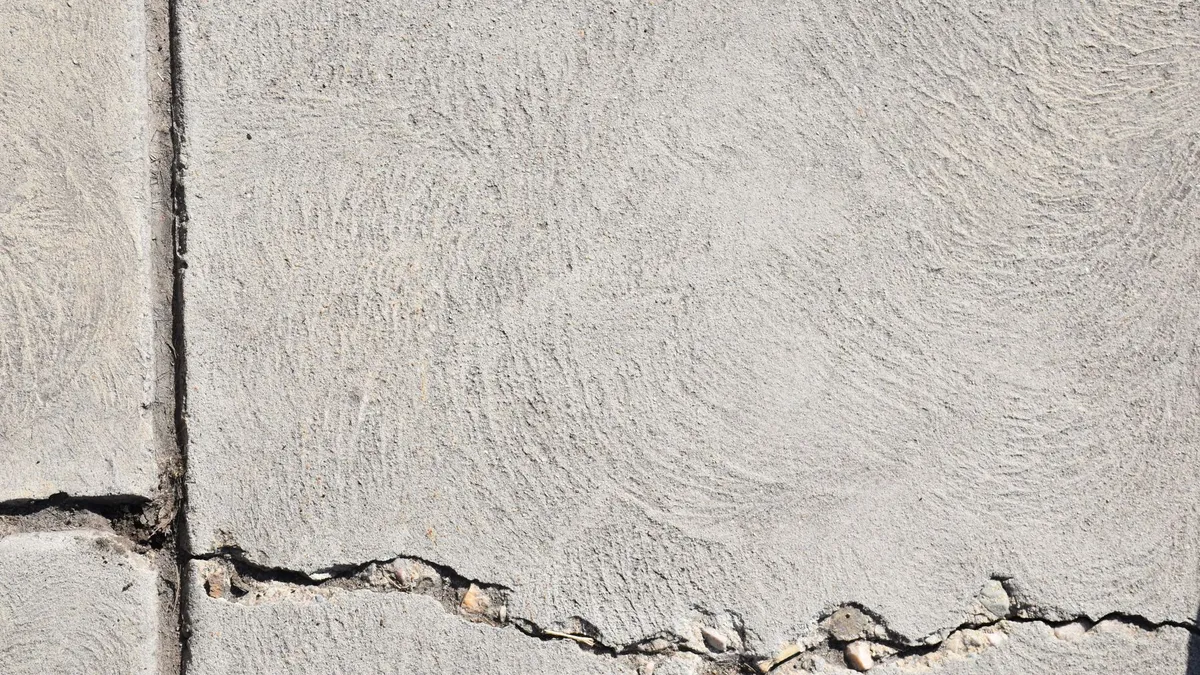
Not every line is the same: dormant hairline cracks are filled, while joints cut for concrete movement are kept in the coating too. The wrong call means the crack reappears in the coating.
Crack or joint?
Joints are cut deliberately to control shrinkage and thermal movement; cracks form unintentionally. They are treated differently.
Dormant cracks
Hairline and fine cracks that have stopped moving are opened, cleaned and filled with suitable resin mortars, then levelled with the surface.
Movement joints
If expansion and movement joints are coated over, the coating cracks along that line. These joints are kept open through the coating and filled with a flexible sealant.
Spalled edges
Joint edges broken by forklift traffic must be repaired before coating; otherwise the damage keeps growing.
Reflective cracking
Cracks coated without repair soon reappear on the surface. Mapping cracks during preparation is a good start.
Frequently Asked Questions
Are concrete joints coated over?
Movement joints are not; they are kept through the coating and filled with a flexible sealant.
What happens to hairline cracks?
If dormant, they are cleaned and filled with resin mortar.
Does an unrepaired crack affect the coating?
Yes; it soon reflects through to the surface.
Would you like a site survey for your floor? HBK Epoxy Flooring, based in Gaziantep, offers free surveys and quotations in the surrounding provinces.
0507 597 9537 WhatsAppRelated articles
Concrete Moisture Testing: Why and How Before Coating
Concrete can look dry yet hold moisture inside. Under a coating this moisture creates vapour pressure; work started without testing may later blister.
Read article ›
Stains and Scratches on Epoxy Floors: Prevention, Cleaning and Renewal
Epoxy is tough but not scratch-proof. Most stains come out with correct cleaning; deep scratches are removed with a topcoat renewal without removing the floor.
Read article ›
Anti-Slip Epoxy: How to Choose the Right Texture
More texture is not always better: too much makes cleaning harder. The right level depends on how wet and oily the area is.
Read article ›