

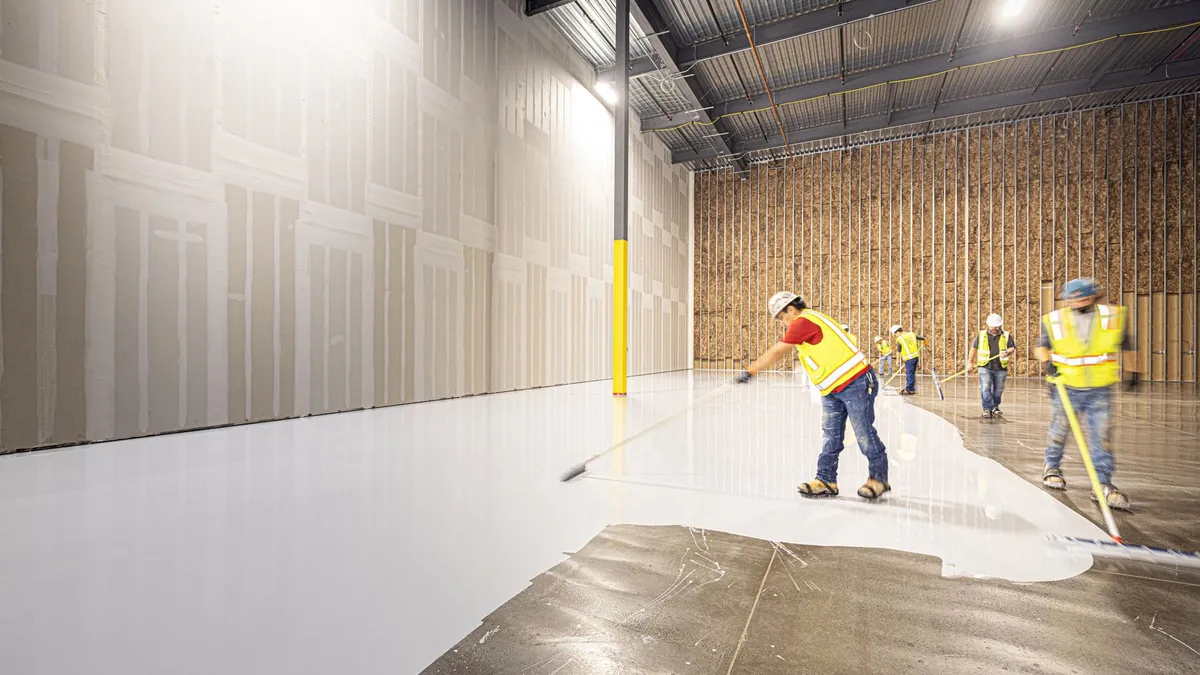
Renewing a factory floor does not have to halt production for weeks. Dividing the area into phases and choosing fast-curing systems lets the work finish while operations continue.
Why phase the work?
Many facilities cannot close completely for a new floor. The area is divided into sections that are coated in turn while work continues elsewhere. A phased installation spreads the job over a longer schedule but keeps production running; the quality of the plan decides the result.
The zone plan
Phases follow machine layout, dispatch routes and joint lines. The start and end boundaries of each phase are marked in advance. The plan is drawn on a sketch with the date of each phase and the routes that will close at that time, and shared with the production, maintenance and health and safety teams.
Phase boundaries
Where possible, boundaries are placed on existing joints or on wall, column or machine lines, so the junction between two phases is less noticeable. To avoid differences in shade between adjoining phases, data sheets ask for material from the same production batch to be used (colour differences and patchiness).
Time windows
Critical zones can be done at weekends, on public holidays or during planned maintenance shutdowns. Long holidays suit large areas. We give sector-specific example plans in commercial kitchen flooring and cold store flooring.
Fast-curing systems
For short windows, systems that return to service sooner can be chosen. For example, the data sheet for the PMMA-based Sikafloor-32 Pronto states that the system, about 2–4 mm thick, can take foot traffic after about 80 minutes even at 0 °C and about 60 minutes at +10 °C, and is fully cured in about 3 hours. The choice is weighed against the required performance and site conditions.
Conditions for a fast system
The same data sheet gives air and substrate temperatures of 0 to +30 °C and relative humidity of at most about 80%; the substrate and the fresh material must be at least 3 °C above the dew point (dew point). After application the floor is protected from damp, condensation and water for at least one hour. It is not used on substrates with rising moisture (concrete moisture testing).
Limits of a fast system
Fast curing is not the right choice for every section. The same data sheet gives dry heat limits of +40 °C permanently, +50 °C for at most two days and +60 °C for one hour; it withstands moist heat such as steam cleaning up to +80 °C only temporarily, as a broadcast system about 3–4 mm thick and without simultaneous chemical and mechanical exposure. Hot process areas need a different system.
Questions for the plan
For each phase, answer at the start: On which day, and for how many hours, will the section close? Will machinery and racking be moved? Does the curing time of the chosen system fit the window? How will neighbouring sections be protected from dust and odour? Against what criteria will the phase be handed over?
Odour and ventilation
Reactive acrylic systems give off a characteristic odour during application and before full cure; once fully cured they leave no taint. The data sheet asks for the air in a confined space to be changed at least seven times an hour, with forced fresh air supply and extraction using spark-free equipment. General rules are in epoxy odour and ventilation.
Where food is present
The data sheet says such systems must not be applied in the presence of food, and that all foodstuffs, packaged or not, must be completely isolated from the works during application and until full cure. Unpackaged goods are removed from the area. We cover the flooring needs of food plants in food plant flooring.
Protecting working areas
To protect working areas, dust-controlled grinding, screening, ventilation and temporary pedestrian and forklift routes are planned. Temporary routes are marked with tape and signs; permanent lines are painted once the coating is finished (forklift lane markings).
Handing over each phase
Each phase is handed over once its own curing time has passed, and heavy traffic and racking start according to the times in the data sheet. At handover, the application date, site readings and batch numbers for that phase are recorded. We cover a new floor's first weeks in the first 30 days after coating.
Frequently Asked Questions
Can floors be coated while a factory runs?
Yes; by dividing the area into phases while work continues.
How are phases decided?
By machine layout, dispatch routes and joint lines; where possible, boundaries are placed on existing joints.
How are dust and odour controlled?
With dust-controlled equipment, screening and ventilation; for fast-curing acrylic systems the data sheet asks for at least seven air changes an hour.
How soon can a fast-curing floor be used?
It depends on the product and temperature. For example, the PMMA-based Sikafloor-32 Pronto data sheet gives foot traffic after about 60 minutes at +10 °C and full cure in about 3 hours.
Would you like a site survey for your floor? HBK Epoxy Flooring, based in Gaziantep, offers free surveys and quotations in the surrounding provinces.
0507 597 9537 WhatsAppRelated articles

Bike Lane Width and Coloured Surfacing: What Are the Rules?
In the figures of Turkey's Bicycle Paths Regulation a one-way cycle lane and a separated cycle path are 130 cm wide, and a two-way rural cycle band is 230 cm. Junction crossings are painted in non-slip blue; if the rest of the path is painted, the colour is again blue.
Read article ›
Epoxy Coverage: How Many m² Does 20 kg of Epoxy Cover?
How far epoxy goes depends not on the weight of the kit but on the thickness of the layer and the density of the product; the calculation takes minutes.
Read article ›
10 Questions to Ask Before Accepting a Flooring Quote
Two quotes for the same square metres can differ widely, often because they do not describe the same job. The right questions make quotes truly comparable.
Read article ›