

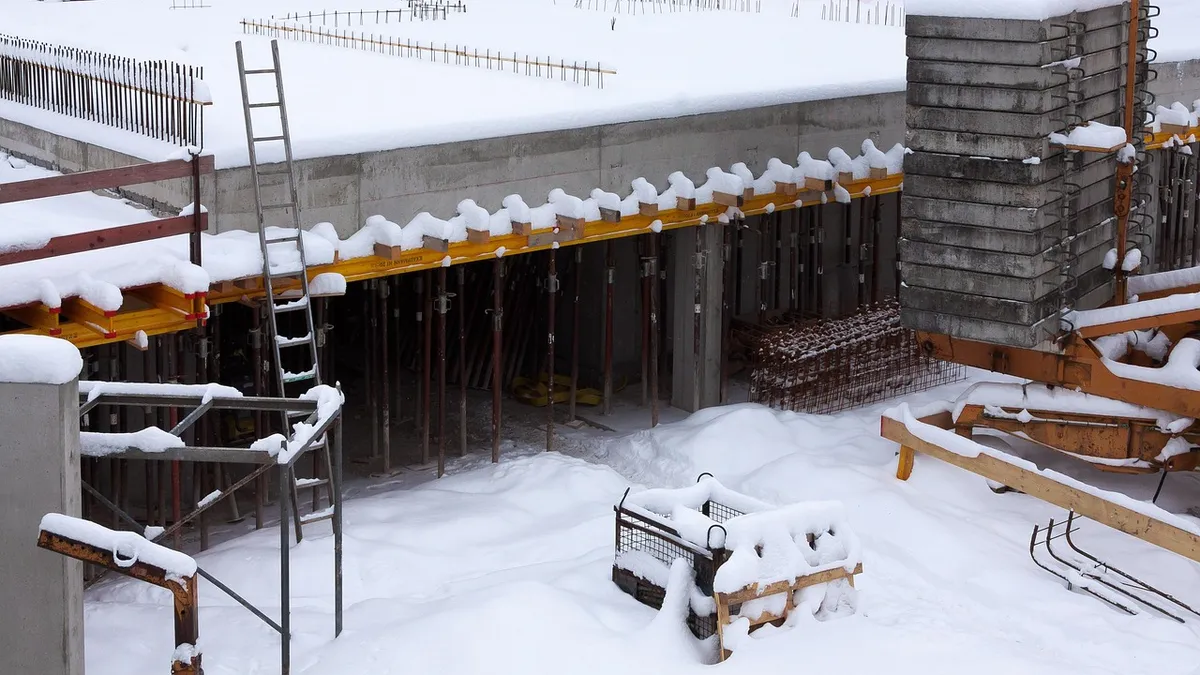
Concrete can be poured in winter; what matters is not the air but the temperature of the concrete and keeping it from freezing until it gains strength. TS 1248 sets the rules.
What does “cold weather” mean for concrete?
Under the Turkish standard TS 1248 (preparing, placing and curing concrete in abnormal weather), concrete is in “cold weather” when the average daily air temperature stays below +5 °C for three consecutive days and no half-day in that period rises above +10 °C. The daily average is the mean of that day's highest and lowest temperatures. The January 2026 technical bulletin of the Turkish Ready Mixed Concrete Association names the continental climate of Central, Eastern and South-eastern Anatolia as the riskiest for frost, so winter pours in and around Gaziantep also need to be planned in advance.
At what temperature can concrete be poured?
The standards do not give a single “forbidden temperature”; they set requirements for the temperature of the concrete and for its protection. Under TS EN 206, fresh concrete should not be below +5 °C; in practice concrete below +10 °C is not recommended, and 15–20 °C is considered ideal.
For cold weather, TS 1248 tabulates minimum concrete temperatures according to the air temperature and the smallest section dimension of the element: during placing and throughout the protection period the concrete should not fall below 5–13 °C, depending on the section. Thin elements such as slabs, shear walls and walls lose heat more easily, so they need higher temperatures and more careful protection.
The real risk: freezing at an early age
The reaction of cement with water (hydration) slows down sharply once the concrete drops below 5 °C. Unlike pure water, the water in concrete starts to freeze at roughly −2 to −4 °C; ice takes up about 9% more volume than water and builds pressure in the pores. Concrete that freezes at an early age can lose up to 50% of its 28-day compressive strength, and its durability is permanently affected.
Under TS 1248, concrete must be protected from freezing until it reaches a compressive strength of at least 4 MPa. How long this takes depends on the cement type, the water/cement ratio and the curing temperature; the first 24 hours (48 hours in severe cold) are the most critical.
Before and during the pour
- Watch the forecast not only for the day of the pour but for the following nights; if frost is expected, have covers, heaters and windbreaks ready in advance.
- Never pour onto frozen ground or into icy or snow-filled formwork. Thaw the ground and clear ice from the formwork and reinforcement.
- Agree winter measures with the ready-mix plant beforehand: heated mixing water, accelerating or antifreeze admixtures and a suitable cement type are decided at this stage.
- Schedule the pour for the warmer hours of the day, place the concrete quickly, and measure and record its temperature.
Protection after the pour: covers, heat and time
The heat released by the cement has to be kept in the concrete. Slabs are covered with insulated blankets or polystyrene boards, edges and corners get extra protection, and windbreaks are set up in windy weather. The space may be heated if necessary, but heater exhaust must not be directed at the concrete surface: the carbon dioxide it releases can cause carbonation of the fresh concrete.
The minimum protection periods in TS 1248 depend on the conditions the concrete will face:
| Condition of the concrete | Normal concrete | Concrete with accelerator |
|---|---|---|
| No load and no exposure to frost | 2 days | 1 day |
| Exposed to freeze–thaw, not under load | 3 days | 2 days |
| Partly loaded and exposed to freeze–thaw | 6 days | 4 days |
Concrete with mineral additions (fly ash or slag) gains strength more slowly at an early age and should be protected for longer.
Should concrete be watered in winter?
Unlike summer curing, water curing is not preferred in cold weather: watering does not warm the concrete, and water left on the surface increases the risk of freezing. Curing compounds and covers are used to prevent moisture loss from the surface. The recommended minimum curing period is generally 7 days and may vary with the type of element and the method of protection.
Is an antifreeze admixture enough on its own?
Under TS 11746, antifreeze admixtures reduce the protection period and the measures needed by increasing the early heat of hydration and lowering the freezing point of the water in the pores; chloride-free types are preferred. But the admixture is not enough on its own: covers, temperature control and the protection period still apply. Because an overdose of accelerator can increase the risk of cracking, the dosage is set together with the ready-mix plant and the admixture manufacturer.
If the slab will receive a floor coating
Concrete poured in winter gains strength and dries more slowly. For an industrial concrete slab or a power-floated screed that will later receive epoxy or polyurethane, the programme is planned accordingly, and the timing of joint cutting also changes in the cold (see saw-cutting new concrete). The decision to start coating is based not on the number of days that have passed but on concrete moisture testing. We explain the temperature and humidity conditions on the day of application in temperature and humidity when applying epoxy.
Sources: provisions of TS 1248, TS EN 206 and TS 11746; THBB Academy Technical Bulletin 20 (January 2026). For structural elements, decisions on striking formwork and on protection are made by the structural designer and the building inspection firm.
Frequently Asked Questions
At what temperature can concrete be poured?
Fresh concrete should not be below +5 °C and is preferably kept above +10 °C. If the average daily air temperature is below +5 °C for three days in a row, no pour is made without the cold-weather measures in TS 1248.
Should concrete be watered in winter?
No. Water curing is not preferred in cold weather; watering does not warm the concrete and increases the risk of freezing. Curing compounds and insulated covers are used instead.
When is concrete safe from frost?
Under TS 1248, once it has reached a compressive strength of at least 4 MPa. Until then, especially in the first 24–48 hours, it must be protected from freezing.
Can concrete with antifreeze be poured in any cold?
No. The admixture shortens the protection period but does not replace measures such as covers, temperature control and the protection period.
Would you like a site survey for your floor? HBK Epoxy Flooring, based in Gaziantep, offers free surveys and quotations in the surrounding provinces.
0507 597 9537 WhatsAppRelated articles

Choosing Stamped Concrete Patterns and Colours
Two things define how stamped concrete looks: the stamp pattern and the colour. The right choice depends on use, architecture and surrounding materials.
Read article ›
Penetrating Sealers: Protecting Concrete Without a Coating
Not every concrete floor needs a coating. Penetrating sealers soak into the concrete and protect it from dust, water and stains without changing its natural look.
Read article ›
Saw-Cutting Joints in New Concrete Floors: Timing and Spacing
As concrete dries and shrinks it wants to crack somewhere. Joints cut at the right time and spacing make that crack form along a straight line instead of at random.
Read article ›