

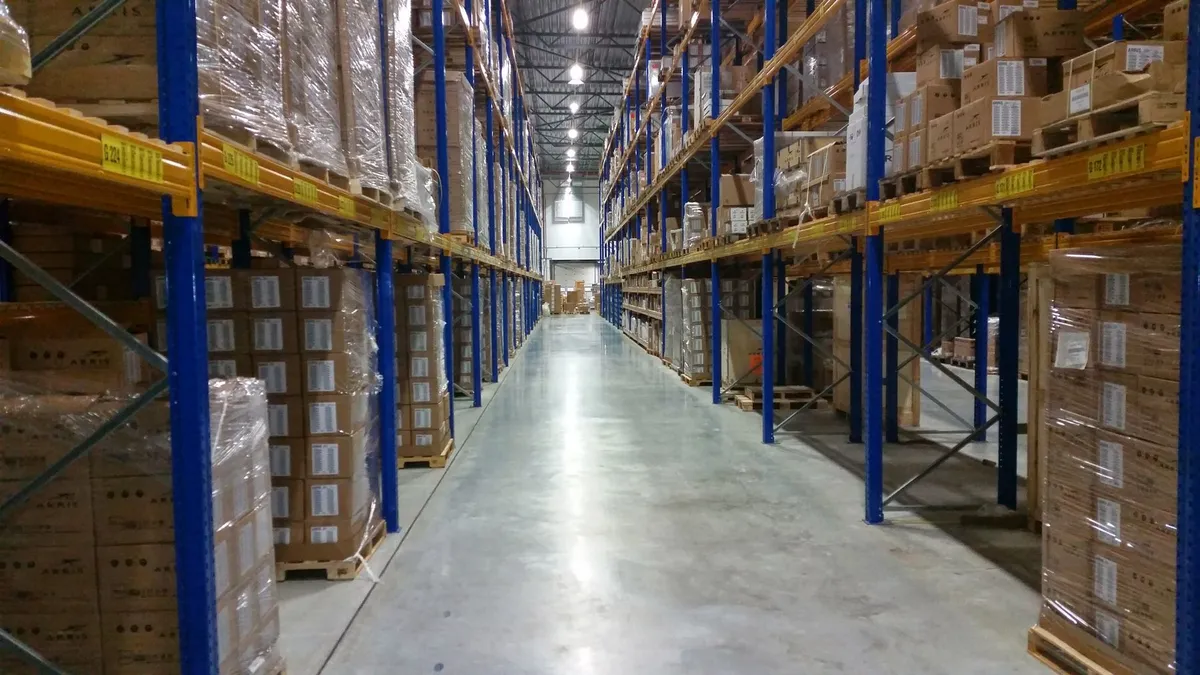
In high-bay warehouses the floor carries heavy loads from rack feet to forklift wheels. The order of coating and racking and the details under the feet must be planned early.
The load under a rack upright
A loaded rack upright transfers a significant load to the floor through a small base plate. The floor's capacity to take it is part of racking design. One racking manufacturer's installation guide requires the floor to be structurally adequate for the rack design loads and able to accept anchors, while accepting no responsibility for the floor's design or performance.
Floor information is part of the project
EN 15620:2021, the standard for racking tolerances, specifically excludes the tolerances and deformation of industrial trucks and floors, and states that it is to be used in conjunction with information on the handling equipment and the floor. Floor flatness is therefore not defined automatically: the racking supplier, the forklift manufacturer and the flooring contractor agree on one value, and that value is written into the contract.
Coating first or racking first?
Coating is usually done before racking goes in, giving a continuous floor with no uncoated gaps under the rack feet. If racks come later, anchor holes and base plate details should be agreed in advance. Heavy installation work waits until the coating has fully cured; precautions for moving heavy equipment are explained in heavy machinery on epoxy.
Setting out
A good installation starts with accurate, straight lines on the floor; the guide asks for the starting point to be fixed with a tape measure and chalk line and for the grid to be kept square. On a coated floor, marks are made with materials that do not damage the surface and can be removed later without leaving traces. Rack rows, aisle lines and walkways are planned together on the same drawing.
Plumb and shims
The floor must be level enough for the racking to be installed plumb. According to the guide, the first bay is plumbed in both directions to within 1/480 of the rack height; on a 6 m rack that is about 12.5 mm. Shims may be placed under the base plates where needed. If the floor is not level but sloping, the guide asks for the rack manufacturer to be contacted before installation starts.
Anchors and coatings
Holes drilled for rack anchors can crack the coating at their edges. Sealing around the hole with resin keeps out moisture and dirt. The example guide requires every rack frame to be anchored to the concrete floor regardless of height; the anchor type, size and number come from the installation drawings, and anchors are installed perpendicular to the base plate within about ±6°.
No forcing after anchoring
The guide stresses that a rack must never be pulled into plumb after the bolts and anchors have been tightened, as this can bend rack members. Forcing it also strains the concrete around the anchor and can start a crack at the edge of the hole. Plumb and alignment are therefore checked before the anchors are tightened.
Aisle flatness
High-lift forklifts in narrow aisles are affected by even small level differences, so flatness matters especially there, and the tolerance the forklift manufacturer requires must be achieved when the concrete is placed; a thin coating does not remove level differences in the slab. Placing and finishing are covered on our industrial concrete slab and power-floated screed pages.
Impact protection
Guards around rack uprights protect both the racking and the coating from forklift impacts. Because the guards are also anchored to the floor, their holes are added to the coating plan. What aisle and walkway lines mean is explained on our forklift aisle marking and warehouse line marking colours pages.
Cleaning under the racks
Dust, stretch film and packaging scraps build up at the foot of the racks. A seamless, sealed surface makes these areas easier to sweep and machine-clean, and regular cleaning also reduces the wear caused by grit carried on forklift wheels.
When the layout changes
When the racking layout changes, the old anchor holes are left open in the coating. They are cleaned out, filled with epoxy mortar and the surface is renewed locally; the new coat may look slightly different in shade (epoxy colour variation). Changes in a working warehouse are planned section by section (phased installation).
Frequently Asked Questions
Is racking installed before coating?
Coating is usually done first, giving a continuous floor.
Do rack anchors damage the coating?
Hole edges can crack; they should be sealed with resin.
Why does the floor matter in narrow aisles?
High-lift forklifts are affected by even small level differences.
Does racking have to be anchored at every height?
One racking manufacturer's installation guide requires all frames to be anchored to the concrete floor regardless of height; the anchor type and number come from the installation drawings.
Would you like a site survey for your floor? HBK Epoxy Flooring, based in Gaziantep, offers free surveys and quotations in the surrounding provinces.
0507 597 9537 WhatsAppRelated articles

Bike Lane Width and Coloured Surfacing: What Are the Rules?
In the figures of Turkey's Bicycle Paths Regulation a one-way cycle lane and a separated cycle path are 130 cm wide, and a two-way rural cycle band is 230 cm. Junction crossings are painted in non-slip blue; if the rest of the path is painted, the colour is again blue.
Read article ›
Epoxy Coverage: How Many m² Does 20 kg of Epoxy Cover?
How far epoxy goes depends not on the weight of the kit but on the thickness of the layer and the density of the product; the calculation takes minutes.
Read article ›
Flooring Without Stopping Production: Planning a Phased Installation
Renewing a factory floor does not have to halt production for weeks. Dividing the area into phases and choosing fast-curing systems lets the work finish while operations continue.
Read article ›