

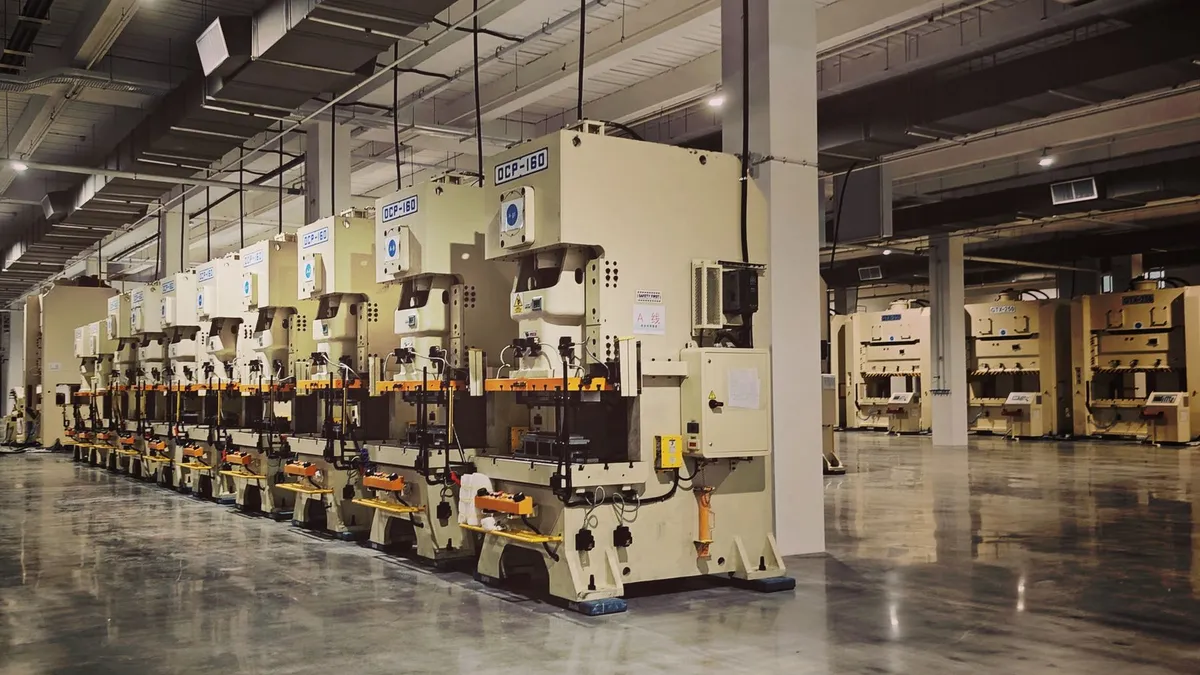
Installing machinery on a new floor is one of the riskiest moments for a coating. Without planning, point loads, dragged equipment and anchor holes can damage it in the first week.
Install first or coat first?
Where possible heavy machines are placed before coating and the coating is worked around them. If installation comes later, a protection plan is needed. Both routes have pros and cons: installing first protects the coating, but the area under the machine stays bare, and if the machine is ever moved that uncoated patch is exposed. Coating first gives a single continuous floor that is easier to clean, but the moving and installation day must then be managed carefully.
Can the concrete carry the load?
A coating adds no strength to a floor; the concrete carries the load. Even for coating, the substrate needs a certain strength: the Sikafloor-161 data sheet, for example, requires at least about 25 N/mm² compressive strength and 1.5 N/mm² tensile strength. Foundations for heavy presses, machine tools and vibrating machines are designed separately from the machine maker's data and the structural design. Weak or cracked areas of concrete must be repaired before coating; we describe the options in renovating damaged concrete floors.
Point loads
Machine feet put a heavy load on a small area. Load-spreading plates under the feet prevent the coating from being crushed. This matters even more with machines that run hot: the Sikafloor-161 data sheet notes that high point loads combined with high temperatures can leave imprints in the resin. Where heavy traffic and impact are expected, thick systems such as epoxy mortar are preferred over a thin coat of paint. Similar principles apply to racking feet (racking and the floor).
During moving
Dragging machines or moving them on steel rollers scratches and tears the coating. Temporary protective boards should be laid along the route, with their joints taped so that wheels do not catch in the gaps. Machine skates and wheels must be clean; a metal burr or grit stuck to a wheel leaves a long scratch wherever there is no board. If a forklift is used, the load must sit balanced on the forks and the machine must not be dropped on its edge when it is set down.
Anchor holes
The coating can crack around anchor holes drilled through it; sealing the hole edges with resin keeps out moisture and chemicals. Holes are drilled only after the coating has fully cured, and drilling dust is swept up immediately. If anchor positions are marked in advance, the coating crew can reinforce those points where needed.
Vibration, oil and coolant
Oil, coolant and metal swarf collect around a running machine. Using drip trays and cleaning spills without delay extends the life of the coating. Read how long a coating can be expected to resist each fluid from the product data sheet, as described in how to read a chemical resistance chart.
Wait for full cure
Heavy machinery should be moved in only after the coating has reached full chemical resistance. The Sikafloor-264 data sheet, for example, gives about 24 hours for foot traffic, about 4 days for light traffic and about 7 days for full cure at +20 °C; in a cold factory hall these times are longer. If work has to continue without stopping production, the zones are sequenced accordingly (planning a phased installation).
Installation day checklist
- Has the curing time passed, and are surface temperature and site conditions suitable?
- Is the route covered with boards and are the joints taped?
- Are the foot plates and anchor points ready?
- Will the safety lines around the machine be marked afterwards? (safety line marking)
Common mistakes
- Setting the installation date without checking the curing time.
- Sliding the machine across the floor without protective boards.
- Leaving the edges of anchor holes unsealed.
- Running dirty wheels and skates over the boards without cleaning them.
- Letting oil and coolant collect around the machine for days.
- Using small, thin or sharp-edged plates under the feet.
For heavy vehicle workshops and hangars, see also our article on workshop and hangar floors.
Frequently Asked Questions
Should machines be installed before coating?
Where possible, yes; otherwise a protection plan is needed covering the route, foot plates and curing time.
Can machine feet crush the coating?
Without load-spreading plates, point loads can cause damage; with machines that run hot, the risk of imprints in the resin increases.
Can anchors be fixed into a coated floor?
Yes; holes are drilled after full cure and their edges should be sealed with resin.
When can heavy machinery go onto a new coating?
After full cure. The Sikafloor-264 data sheet, for example, gives about 7 days for full cure at +20 °C; it takes longer in a cold building.
Would you like a site survey for your floor? HBK Epoxy Flooring, based in Gaziantep, offers free surveys and quotations in the surrounding provinces.
0507 597 9537 WhatsAppRelated articles

What Is an Epoxy Primer? Why It Is Used and How It Is Applied
The primer is the first coat that bonds an epoxy coating to concrete. It seals the pores, binds fine surface dust and helps the following coats sit on a sound base.
Read article ›
How to Calculate the Dew Point: The 3 °C Rule for Floor Coatings
If the floor temperature approaches the dew point, an invisible film of water forms on the new coating. Measuring temperature and humidity tells you the risk in minutes.
Read article ›
Concrete Moisture Testing: Why and How Before Coating
Concrete can look dry yet hold moisture inside. Under a coating this moisture creates vapour pressure; work started without testing may later blister.
Read article ›