

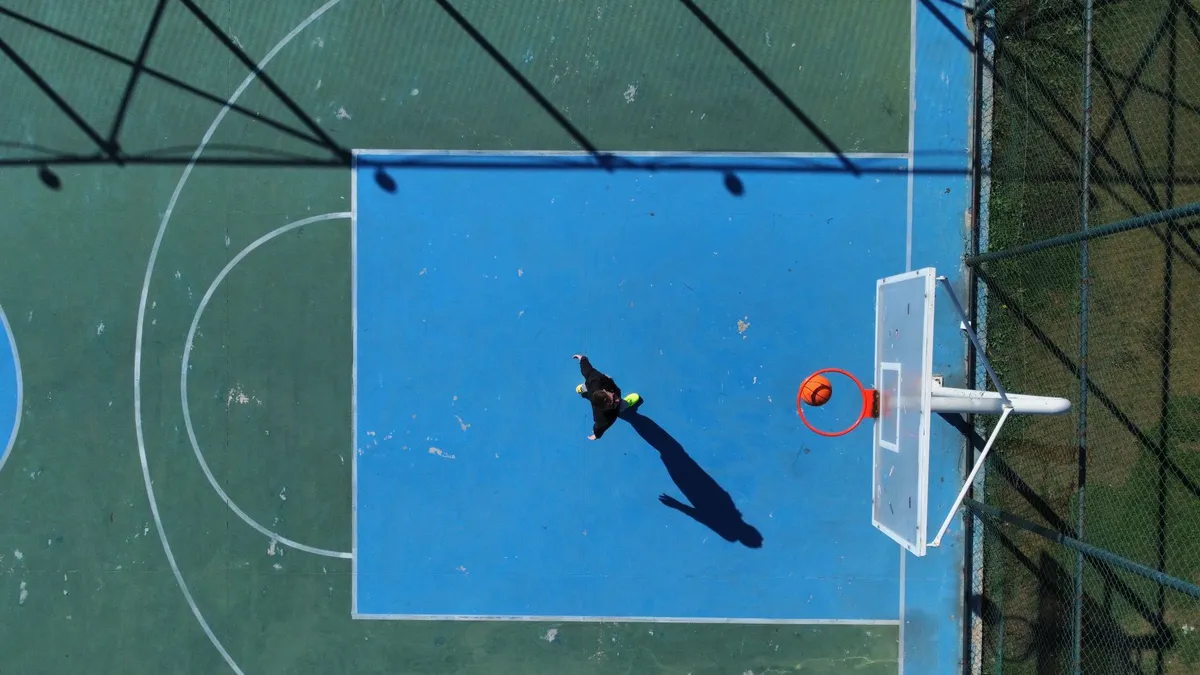
An official basketball playing area is 28×15 metres, plus a safety margin around it. Where space is tighter, a half court or scaled layout can be planned.
Official size
Under FIBA rules the basketball playing area is 28 metres long and 15 metres wide. It is measured from the inner edge of the boundary line; the lines mark the limit of the court but are not part of it. The values in this article are taken from the 2026 rulebook and its equipment appendix, valid as of 1 October 2026.
Safety margin
An obstacle-free margin is left around the playing area so players can run past the lines. The rules require this lane to be at least 2 m wide, so the floor measures at least 32×19 m. Any obstruction, including the seated head coach and substitutes, must be at least 2 m from the court. The equipment appendix asks for this lane to be in a sharply contrasting colour, and on an outdoor court the falls are planned to include it (outdoor court drainage and falls).
Lines and colours
All lines must be 5 cm wide, of a solid colour and in high contrast with the floor. All boundary lines are the same colour, and paired markings such as the restricted areas, free-throw semi-circles and 3-point lines match on both half-courts. The centre line and centre circle may be a different colour (multi-sport court lines).
Centre line and circles
The centre line runs parallel to the endlines from the mid-point of the sidelines and extends 0.15 m beyond each sideline. The centre circle and the free-throw semi-circles have a radius of 1.80 m measured to the outer edge of the circumference; the free-throw semi-circles are centred on the mid-point of the free-throw lines.
Free-throw line and restricted area
The furthest edge of the free-throw line is 5.80 m from the inner edge of the endline, and the line is 3.60 m long. The outer edges of the lines bounding the restricted area are 2.45 m from the mid-point of the endline, and these lines end at the extension of the free-throw line.
The 3-point line
The 3-point arc has a radius of 6.75 m, measured from the point on the floor beneath the exact centre of the basket to the outer edge of the arc; this point lies 1.575 m from the inner edge of the mid-point of the endline. The arc joins two parallel lines perpendicular to the endline, whose outer edges are 0.90 m from the inner edge of the sidelines.
Hoop position
The hoop post stands outside the playing area, while the backboard projects over the court. According to the equipment appendix, the central vertical line on the front of the backboard, extended down to the floor, must touch a point 1.20 m from the centre of the inner edge of the endline. The backboard measures about 1.80 × 1.05 m, and the top edge of the ring is 3.05 m above the floor.
Support structure and ceiling height
The front padding of the backboard support structure must be at least 2 m from the outer edge of the endline in top-level competitions and at least 1 m in other competitions. In indoor halls, the ceiling or the lowest obstruction above the court must be at least 7 m high; we cover the hall floor itself in indoor sports hall flooring.
Small spaces
Where a full court does not fit in a residential, school or villa garden, a single-hoop half court is a good solution. A useful reference for sizing is FIBA's 3x3 layout: a 15×11 m playing area with 2 m behind the baseline, 1.5 m on the short sides (exceptionally at least 1 m) and 1 m on the long side opposite the backstop (courts in residential complexes). For school courts, see also school playground courts.
Lay out before surfacing
Dimensions are marked on site before surfacing begins, and colour zones and lines are planned accordingly. The FIBA equipment appendix requires paints or stickers applied to the floor, if they are not covered by an additional coat of finish, to meet the same slip and gloss criteria as the rest of the floor (acrylic basketball court, how many coats an acrylic court needs).
Frequently Asked Questions
How big is an official basketball court?
Under FIBA rules the playing area is 28×15 metres; with the obstacle-free lane of at least 2 m around it, the floor measures at least 32×19 m.
Can a small garden have a court?
Yes; a single-hoop half court is a good solution. FIBA's 3x3 layout, with its 15×11 m playing area, is a good starting size.
Is space needed around the court?
Yes; the rules require an obstacle-free lane at least 2 m wide around the playing area.
How high is a basketball hoop?
The top edge of the ring is 3.05 m above the floor; the FIBA equipment appendix allows a deviation of no more than about 6 mm.
Would you like a site survey for your floor? HBK Epoxy Flooring, based in Gaziantep, offers free surveys and quotations in the surrounding provinces.
0507 597 9537 WhatsAppRelated articles
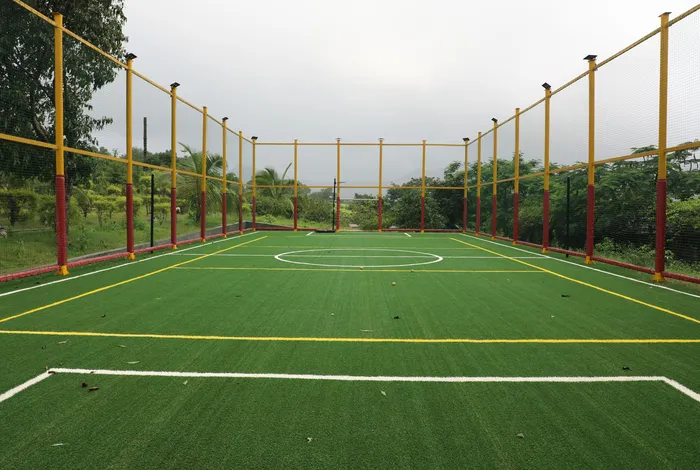
Small-Sided Pitch Sizes: How Big Is a 6+1 or 7+1 Pitch?
The Laws of the Game define no size for 6+1 and 7+1 small-sided pitches. For seven-a-side teams the English FA recommendation of about 55 × 37 m, and for eight-a-side teams the 70 × 50 m used in TFF Istanbul’s U11 league, can serve as references.
Read article ›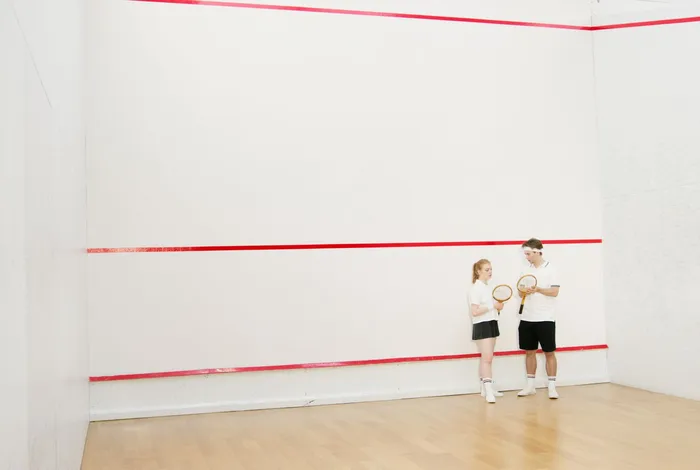
Squash Court Dimensions: Wall Lines and Floor
An international singles squash court is 9.75 m long and 6.40 m wide. The front wall line is at 4.57 m, the service line at 1.78 m and the back wall line at 2.13 m; the top of the tin is 48 cm above the floor.
Read article ›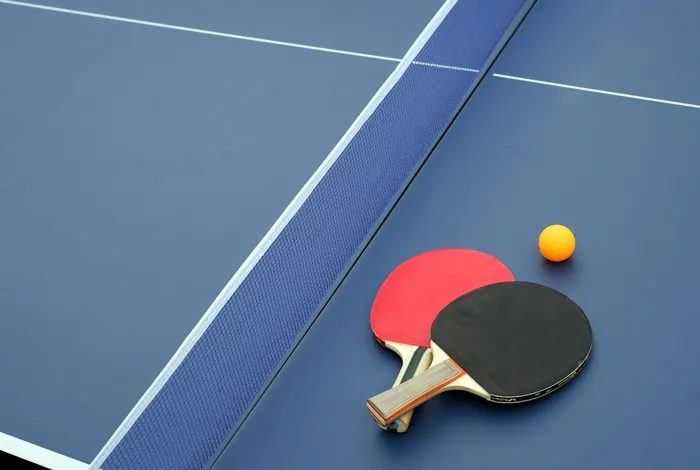
Table Tennis Table Dimensions: Height, Net and Playing Surface
A table tennis table has a playing surface 2.74 m long and 1.525 m wide, 76 cm above the floor. The net stands 15.25 cm above the playing surface. The figures are in chapter 2 of the ITTF Laws.
Read article ›