

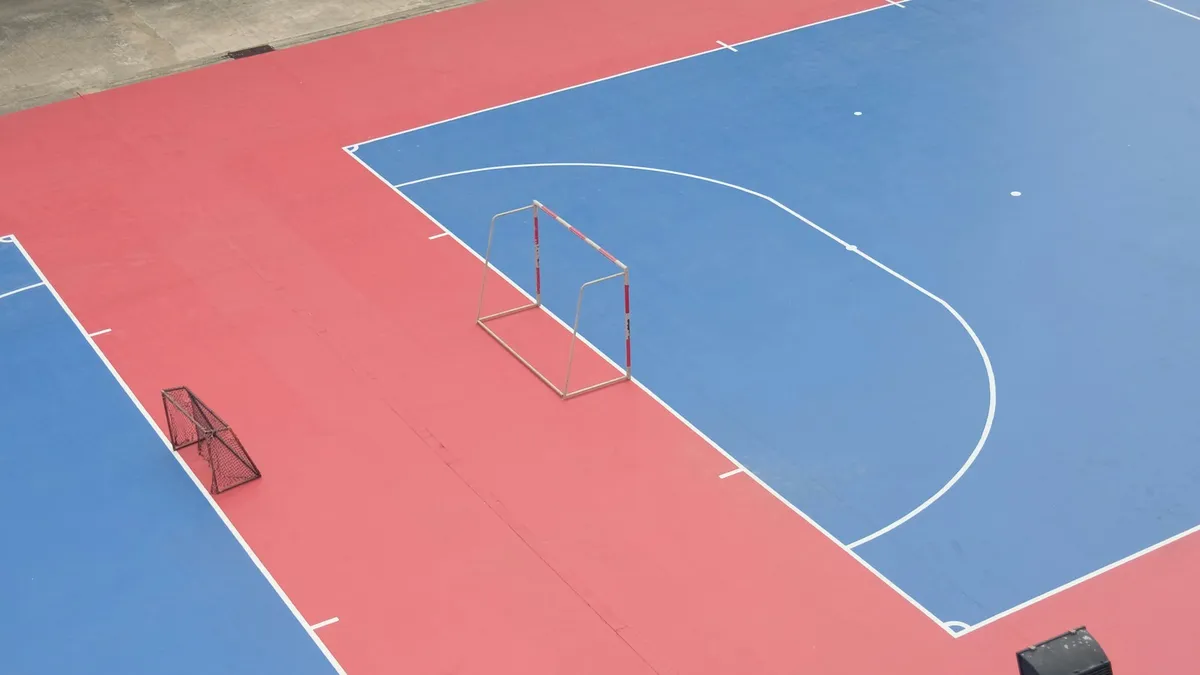
For international matches a futsal pitch is 38–42 metres long and 20–25 metres wide. The penalty area, penalty marks, goals and surface are each defined in the FIFA Futsal Laws of the Game.
How big is a futsal court?
Futsal pitch dimensions are set out in Law 1, "The Pitch", of FIFA's Futsal Laws of the Game. Under the 2025–26 edition the pitch is rectangular and the touchline must always be longer than the end line. The Laws give a range rather than a single size, and a competition may set its own dimensions within it.
| Measurement | Non-international matches | International matches |
|---|---|---|
| Length (touchline) | 25–42 m | 38–42 m |
| Width (end line) | 16–25 m | 20–25 m |
| Line width | 8 cm | 8 cm |
| Goal (inside) | 3 × 2 m | 3 × 2 m |
For a new hall, the international range is a safe target. A 40×20 metre playing area falls within it and also matches a handball court, so the two sports can share one floor in a multi-purpose hall. For the colour plan when other sports' lines share the surface, see our article on multi-sport court lines.
How are the lines marked?
The pitch is marked with continuous lines; broken lines are not allowed. All lines are 8 cm wide, must not be slippery and must be clearly distinguishable from the colour of the floor. Measurements are taken from the outside of the lines, because a line belongs to the area it encloses. Lines for other sports must be a different colour.
A halfway line joins the midpoints of the two touchlines. At its midpoint there is a centre mark with a 6 cm radius inside a centre circle with a 3 m radius. Each corner has a corner arc with a 25 cm radius. So that defenders retreat 5 m at a corner kick, a mark 8 cm wide and 40 cm long is drawn outside the pitch, 5 m from each corner arc and 5 cm from the end line.
Penalty area and penalty marks
To draw the penalty area, an imaginary 6 m line is drawn from the outside of each goalpost at right angles to the end line. From its end, a quarter circle with a 6 m radius, measured from the outside of the post, is drawn towards the nearest touchline. The tops of the two quarter circles are joined by a 3.16 m line parallel to the goal line.
- Penalty mark: a mark with a radius of 6 cm, 6 m from the midpoint between the goalposts.
- 10 m mark: 10 m from the same point. On either side of it, 5 m away, there is a small mark with a radius of 4 cm.
- Goalkeeper mark: a line 8 cm wide and 40 cm long in the penalty area, 5 m from the 10 m mark; it shows the distance the goalkeeper must keep at a direct free kick beginning with the sixth accumulated foul.
The penalty mark and the 10 m mark are measured from the centre of the mark to the back edge of the goal line.
Substitution zones
The substitution zones are on the touchline in front of the team benches: they start 5 m from the halfway line and are 5 m long. Each end is marked with a line 80 cm long and 8 cm wide, 40 cm of which is drawn on the pitch and 40 cm off it. These zones and the benches should be built into the hall layout from the start.
Goal size
Each goal stands at the centre of an end line: 3 m between the posts (inside) and 2 m from the lower edge of the crossbar to the floor. The posts and crossbar have the same width as the goal line, 8 cm, and must be a different colour from the pitch. The Laws require goals not to be fixed to the floor, but to have an adequate stabilising system, such as weight at the back, so that they cannot tip over. Goal positions should be planned so as not to damage the floor coating.
What surface should a futsal court have?
The Laws require a flat, smooth, non-abrasive surface, preferably wood; surfaces dangerous to players and officials are not permitted. For international competitions, FIFA recommends a floor from a company licensed under its futsal surface quality programme. Artificial turf is allowed only in exceptional cases, in domestic competitions and where the competition rules permit it.
In indoor halls, polyurethane sports floors are used alongside timber. We compare the two in our article on indoor sports hall flooring, and you will find an overview of the systems on our types of sports flooring page. Whichever covering is chosen, the moisture of the concrete base should be measured before installation (concrete moisture testing).
Planning a hall in winter
Because futsal is played indoors, floor renewal is planned around the hall's calendar. If a floor is laid in an unheated hall between November and March, floor temperature and humidity must stay within the data sheet limits, and lines are painted only after the waiting time it states. If the hall will also carry basketball and volleyball lines, our articles on basketball court dimensions and volleyball court dimensions will help. For the full-size football pitch see football pitch dimensions.
Frequently Asked Questions
How big is a futsal court?
Under the FIFA Laws, the length is 25–42 m and the width 16–25 m for non-international matches; for international matches the length is 38–42 m and the width 20–25 m. The touchline is always longer than the end line.
How big is a futsal goal?
The inside dimensions of the goal are 3 m wide and 2 m high. The posts and crossbar are 8 cm wide.
How far is the penalty mark in futsal?
The penalty mark is 6 m from the midpoint between the goalposts. There is also a second mark 10 m away, the 10 m mark.
What surface should a futsal court have?
The Laws require a flat, smooth and non-abrasive surface, preferably wood. Polyurethane sports floors are also used in indoor halls; artificial turf is allowed only in exceptional cases and where the competition rules permit it.
Would you like a site survey for your floor? HBK Epoxy Flooring, based in Gaziantep, offers free surveys and quotations in the surrounding provinces.
0507 597 9537 WhatsAppRelated articles
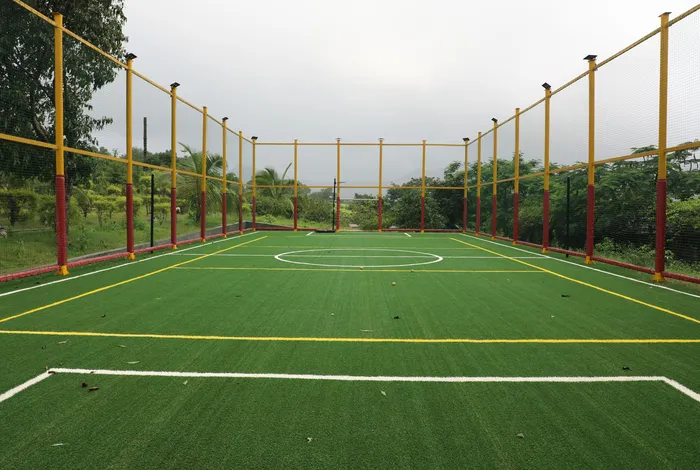
Small-Sided Pitch Sizes: How Big Is a 6+1 or 7+1 Pitch?
The Laws of the Game define no size for 6+1 and 7+1 small-sided pitches. For seven-a-side teams the English FA recommendation of about 55 × 37 m, and for eight-a-side teams the 70 × 50 m used in TFF Istanbul’s U11 league, can serve as references.
Read article ›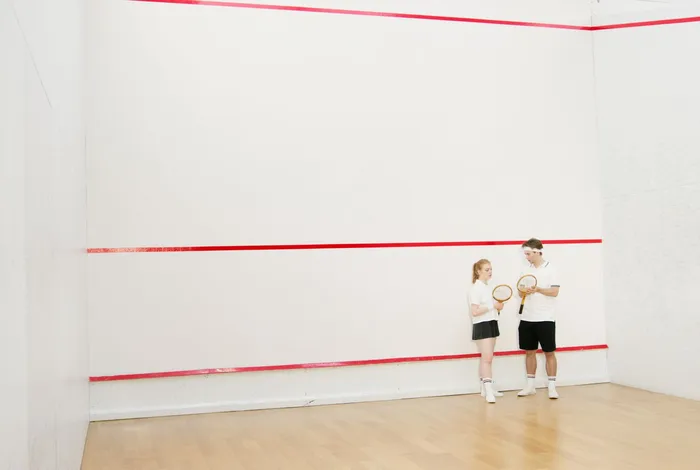
Squash Court Dimensions: Wall Lines and Floor
An international singles squash court is 9.75 m long and 6.40 m wide. The front wall line is at 4.57 m, the service line at 1.78 m and the back wall line at 2.13 m; the top of the tin is 48 cm above the floor.
Read article ›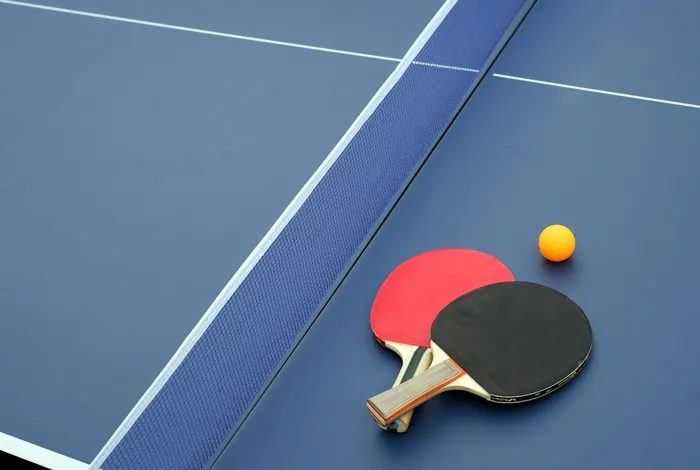
Table Tennis Table Dimensions: Height, Net and Playing Surface
A table tennis table has a playing surface 2.74 m long and 1.525 m wide, 76 cm above the floor. The net stands 15.25 cm above the playing surface. The figures are in chapter 2 of the ITTF Laws.
Read article ›