

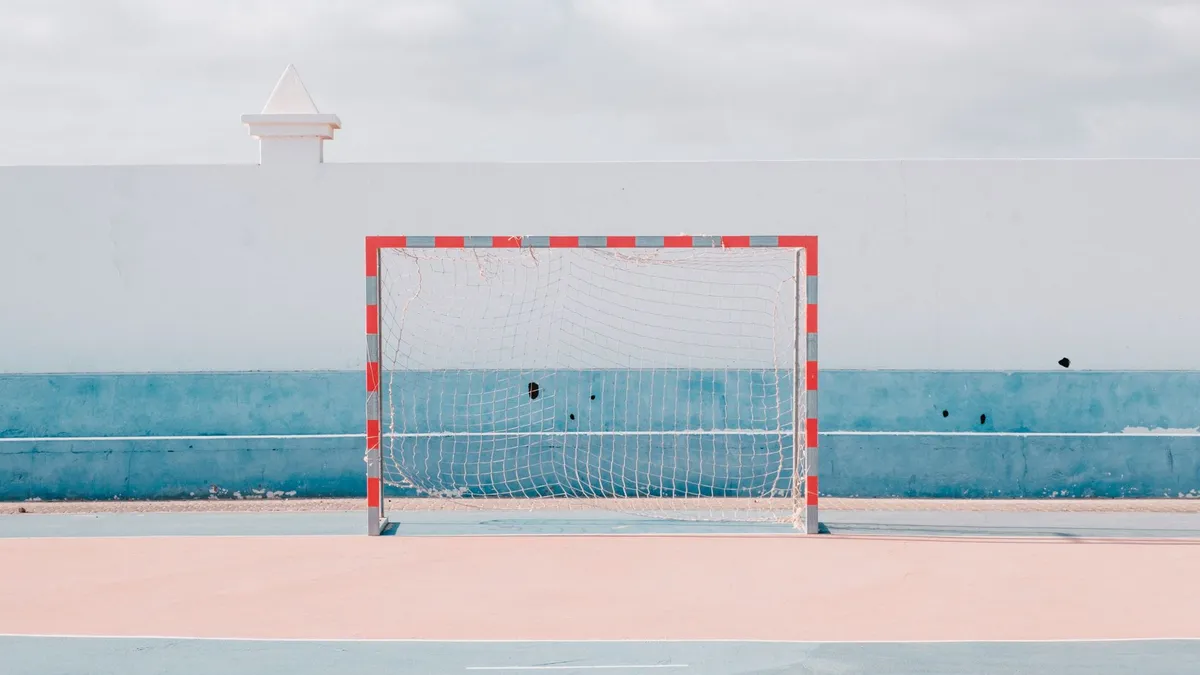
A handball court is a rectangle 40 metres long and 20 metres wide. The goal area, the 9 metre line, the goals and the safety zone around the court are defined in the IHF Rules of the Game.
How big is a handball court?
Under the Rules of the Game for indoor handball of the International Handball Federation (IHF), the court is a rectangle 40 metres long and 20 metres wide. This article follows the edition that came into force on 1 July 2025. The longer boundary lines are called side lines; the shorter ones are called goal lines between the goalposts and outer goal lines on either side of the goal. Unlike futsal, the size of a handball court is a fixed value, not a range.
| Measurement | Value |
|---|---|
| Playing court | 40 × 20 m |
| Safety zone (minimum) | 1 m along the side lines, 2 m behind the goal lines |
| Total level floor (minimum) | 42 × 24 m |
| Line width | 5 cm (goal line between the posts 8 cm) |
| Goal (inside) | 3 m wide × 2 m high |
| Goal-area line | 6 m |
| Free throw line | 9 m (broken) |
A 40×20 metre handball court falls within the range given for international futsal matches; we explain futsal dimensions in our article on futsal court dimensions.
Safety zone
The Rules call for a safety zone around the court: at least 1 m along the side lines and at least 2 m behind the goal lines. The level, obstacle-free floor must therefore measure at least 42×24 metres. Walls, stand steps, columns and team benches should all stay outside this zone. If this allowance is forgotten in the hall layout, the court markings will not fit later.
Lines
All lines on the court are part of the area they enclose. The goal line between the posts is 8 cm wide; all other lines are 5 cm wide. The Rules also allow the line between two adjacent areas to be replaced by a difference in floor colour; the goal area, for example, can be coated in a colour different from the rest of the court. If the hall carries lines for other sports too, a good colour plan prevents confusion (multi-sport court lines).
Goal area (6 m line)
There is a goal area in front of each goal. The 6 m line that bounds it has two parts: a straight line 3 m long directly in front of the goal, parallel to the goal line and 6 m away from it; and two quarter circles with a radius of 6 m that connect this straight line with the outer goal line. The distance is measured from the rear edge of the goal line, while the radius of the quarter circles is taken from the rear inside corner of the goalposts.
The 9 m, 7 m and 4 m lines
- Free throw line (9 m): a broken line drawn 3 m outside the goal-area line. Both the segments of the line and the spaces between them measure 15 cm.
- 7 m line: a line 1 m long directly in front of the goal, parallel to the goal line and 7 m away from it.
- Goalkeeper's restraining line (4 m): a short line 15 cm long in front of the goal, 4 m from the goal line.
Centre line, throw-off area and substitution line
The centre line connects the midpoints of the two side lines. The 2025 Rules added a throw-off area with a diameter of 4 m at the middle of the centre line; it can be an area in a different colour from the court or simply a circle line. The throw-off area is mandatory for IHF events and senior professional leagues and optional for other events. Each team's substitution line starts at the centre line and is 4.5 m long; its end point is marked by a short line extending 15 cm inside and 15 cm outside the side line.
Goal size
The goal has an inside height of 2 m and an inside width of 3 m. The posts and crossbar have an 8 cm square cross-section; the three sides visible from the court are painted in bands of two colours that contrast clearly with each other and with the background. The goals must be firmly attached to the floor or to the wall behind them. This is an important difference from futsal, where goals are not fixed but stabilised with weight; the fixing points should be planned before the floor is coated.
Handball court surface
The Rules of the Game do not list floor types; for detailed technical requirements for courts and goals they refer to separate IHF guidelines. We compare polyurethane sports floors and timber for indoor halls in our article on indoor sports hall flooring. You will find the options for outdoor school courts in our article on school playground courts, and an overview of the systems we install on our types of sports flooring page.
If volleyball will also be played in the same hall, the volleyball free zone and ceiling height must be taken into account as well (volleyball court dimensions). If a new floor is to be laid in the hall between November and March, the floor temperature and humidity must be kept within the limits in the product data sheet.
Frequently Asked Questions
How big is a handball court?
Under the IHF Rules, the playing court is 40×20 metres. A safety zone of at least 1 m along the side lines and at least 2 m behind the goal lines is left around it.
How big is a handball goal?
The inside dimensions of the goal are 3 m wide and 2 m high. The posts and crossbar have an 8 cm square cross-section.
What do the 6 m and 9 m lines show in handball?
The 6 m line is the boundary of the goal area. The 9 m line is the broken free throw line drawn 3 m outside the goal-area line.
Can handball and futsal be played in the same hall?
Yes. A 40×20 m handball court falls within the international futsal range, and the lines of the two sports are drawn in different colours. Handball goals are fixed, while futsal goals are stabilised with weight.
Would you like a site survey for your floor? HBK Epoxy Flooring, based in Gaziantep, offers free surveys and quotations in the surrounding provinces.
0507 597 9537 WhatsAppRelated articles
Small-Sided Pitch Sizes: How Big Is a 6+1 or 7+1 Pitch?
The Laws of the Game define no size for 6+1 and 7+1 small-sided pitches. For seven-a-side teams the English FA recommendation of about 55 × 37 m, and for eight-a-side teams the 70 × 50 m used in TFF Istanbul’s U11 league, can serve as references.
Read article ›
Squash Court Dimensions: Wall Lines and Floor
An international singles squash court is 9.75 m long and 6.40 m wide. The front wall line is at 4.57 m, the service line at 1.78 m and the back wall line at 2.13 m; the top of the tin is 48 cm above the floor.
Read article ›
Table Tennis Table Dimensions: Height, Net and Playing Surface
A table tennis table has a playing surface 2.74 m long and 1.525 m wide, 76 cm above the floor. The net stands 15.25 cm above the playing surface. The figures are in chapter 2 of the ITTF Laws.
Read article ›