

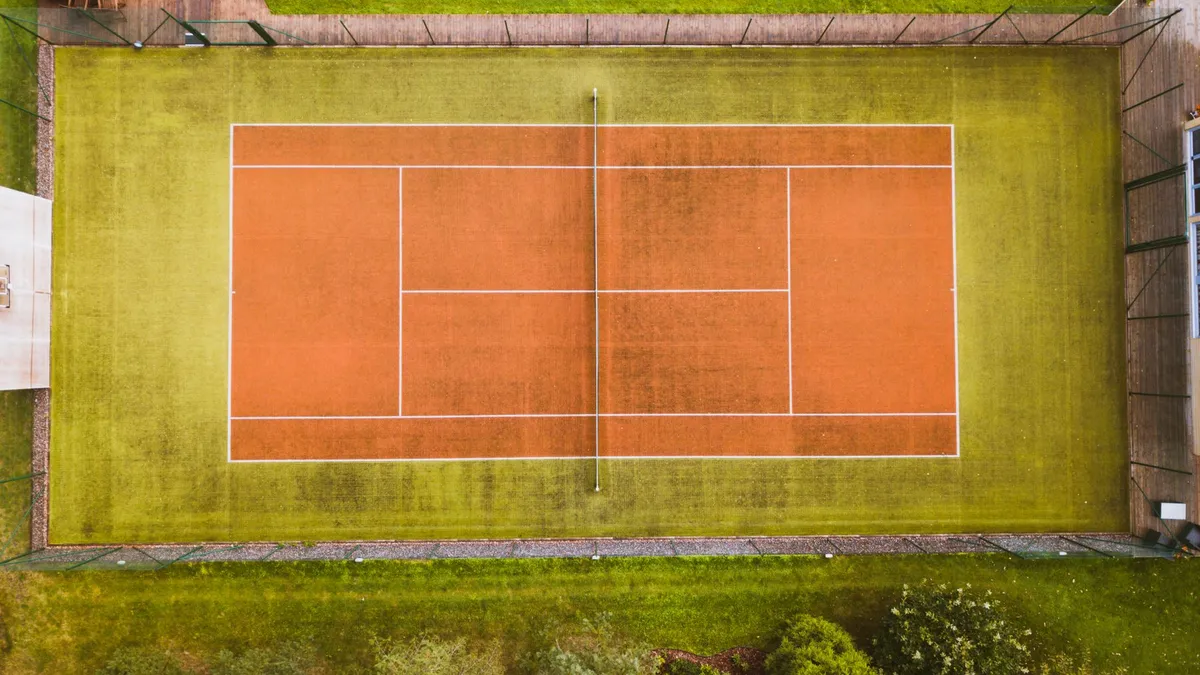
A tennis court is 23.77 metres long and 8.23 metres wide for singles, 10.97 metres for doubles. Service lines, net and line widths are defined in the Rules of Tennis of the International Tennis Federation (ITF).
What are the dimensions of a tennis court?
The size of a tennis court is set out in the first Rule of the Rules of Tennis published by the International Tennis Federation (ITF), under the heading "The Court"; the values below are taken from the 2026 edition. The court is a rectangle 23.77 m (78 ft) long, 8.23 m (27 ft) wide for singles and 10.97 m (36 ft) wide for doubles. The difference between the two widths leaves an alley 1.37 m wide on each side. The playing area measured to the doubles lines is 23.77 × 10.97 m, about 260.8 m², and this figure does not include the clear space around the court.
| Dimension | Value |
|---|---|
| Court length | 23.77 m |
| Singles width | 8.23 m |
| Doubles width | 10.97 m |
| Service line | 6.40 m from the net |
| Net height | 1.07 m at the posts, 0.914 m at the centre |
| Centre service line and centre mark | 5 cm wide |
| Baseline | Up to 10 cm wide |
Service lines and service boxes
As the Rules describe it, two service lines are drawn between the singles sidelines, parallel with the net and 6.40 m from it on each side. The centre service line runs half-way between the singles sidelines and parallel to them, dividing the area between the two service lines into two equal service boxes. From these figures a box is 4.115 m wide, and the distance from the baseline to the service line is 11.885 − 6.40 = 5.485 m. A centre mark 10 cm long is drawn inside the court at the middle of each baseline.
Line widths
The centre service line and the centre mark are 5 cm wide. The other lines may be between 2.5 cm and 5 cm wide; only the baselines may be as wide as 10 cm. Under the Rules, a ball that touches a line is regarded as touching the court bounded by that line, so the line is part of the court. For this reason the paint or tape used for the lines should never be so wide, or so far off position, that it changes the size of the court.
Net and posts
The net is 1.07 m (3.5 ft) high at the posts and 0.914 m (3 ft) high at the centre, where it is held down tightly by a strap. When a doubles net is used for a singles match, two singles sticks are placed 0.914 m outside the singles sideline. Where two sports share a court, the sticks and the strap are therefore planned as part of the set-up.
Clear space around the court
The Rule text describes only what lies inside the lines; the space behind and beside the court appears in ITF competition requirements. The 2021 ITF World Tennis Tour requirements recommend, for international competitions, 6.40 m (21 ft) behind the baselines, 3.66 m (12 ft) outside the sidelines and, where appropriate, a ceiling height of 9.14 m (30 ft). With these values one court including its surrounds measures about 36.57 × 18.29 m, or 669 m². Neighbourhood, school and residential-complex courts cannot always reach these clearances, but they are the first reference when space is being set aside for a new court.
Setting the dimensions out on site
Even when the line dimensions are right, a court does not play well without a suitable fall and a flat surface. We explained the fall that keeps water from collecting on open courts in falls and drainage on outdoor courts. The effect of surface types on ball bounce and pace is covered in tennis court surfaces, and redrawing the lines of an old court is discussed in resurfacing an old tennis court. If you plan to share the court with other sports, see lines on multi-sport courts for the colour plan, and pickleball courts and padel court dimensions for a comparison of other court sizes. The systems we apply are on our acrylic tennis court construction page.
Frequently Asked Questions
How big is a tennis court?
Under the ITF Rules the court is 23.77 m long, 8.23 m wide for singles and 10.97 m wide for doubles. Measured to the doubles lines it is about 260.8 m², not counting the clear space around it.
How high is a tennis net?
The net is 1.07 m high at the posts and 0.914 m at the centre, where it is held down tightly by a strap.
How far is the service line from the net?
The service lines are drawn between the singles sidelines, parallel with the net and 6.40 m from it. The centre service line divides the area between them into two equal service boxes.
How much space is needed behind and beside the court?
The Rule text does not set this. The 2021 ITF World Tennis Tour requirements recommend, for international competitions, 6.40 m behind the baselines and 3.66 m outside the sidelines.
Would you like a site survey for your floor? HBK Epoxy Flooring, based in Gaziantep, offers free surveys and quotations in the surrounding provinces.
0507 597 9537 WhatsAppRelated articles
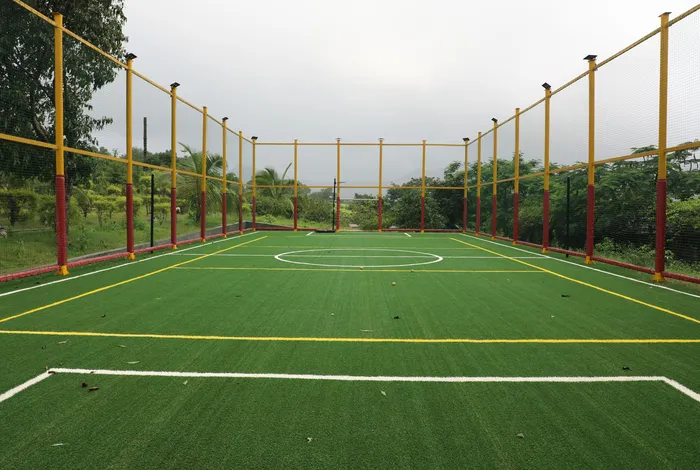
Small-Sided Pitch Sizes: How Big Is a 6+1 or 7+1 Pitch?
The Laws of the Game define no size for 6+1 and 7+1 small-sided pitches. For seven-a-side teams the English FA recommendation of about 55 × 37 m, and for eight-a-side teams the 70 × 50 m used in TFF Istanbul’s U11 league, can serve as references.
Read article ›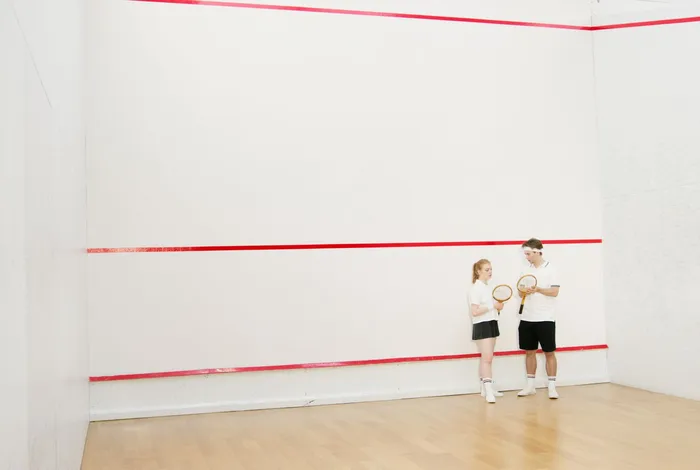
Squash Court Dimensions: Wall Lines and Floor
An international singles squash court is 9.75 m long and 6.40 m wide. The front wall line is at 4.57 m, the service line at 1.78 m and the back wall line at 2.13 m; the top of the tin is 48 cm above the floor.
Read article ›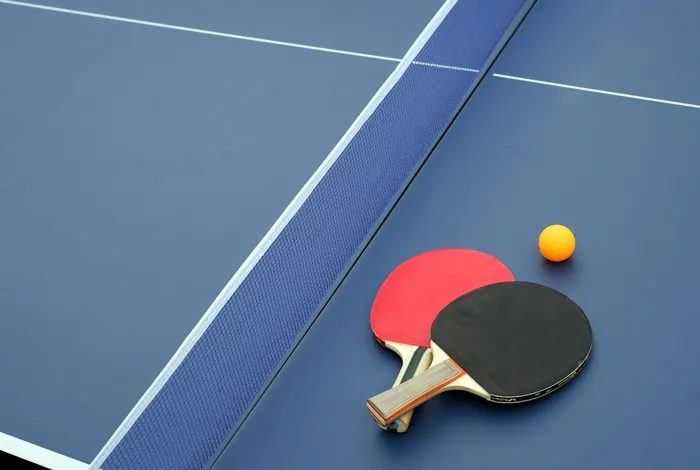
Table Tennis Table Dimensions: Height, Net and Playing Surface
A table tennis table has a playing surface 2.74 m long and 1.525 m wide, 76 cm above the floor. The net stands 15.25 cm above the playing surface. The figures are in chapter 2 of the ITTF Laws.
Read article ›