

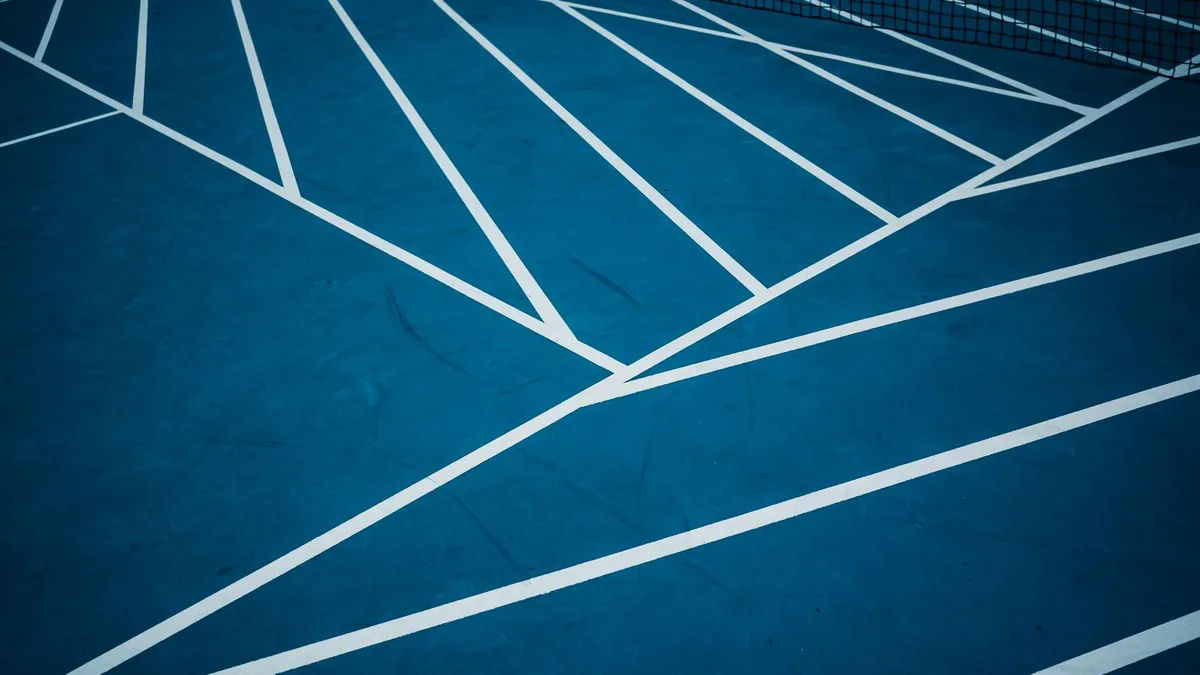
A faded, cracked court or one whose bounce has changed rarely needs demolishing; crack repair and new acrylic coats can get it back into play.
Signs it needs resurfacing
Faded colours, a surface that has lost its texture and become slippery, worn lines, cracks and puddles after rain all show it is time.
Assess first
The type and width of cracks, the condition of the concrete or asphalt base and ponding spots are checked, and the scope of work is set accordingly. The assessment is clearer if it is done twice, on a dry day and after rain: the dry day shows cracks and blistered areas, the wet day shows the low spots that dry last. Findings are marked on a court plan, and the work schedule is built from that plan.
Types of crack
Fine cracks spreading like a web across the surface usually come from the ageing of the old coating and the top layer. Wide cracks that run across the court, with edges that have pulled apart, point to movement in the base and need more extensive repair. Manufacturers are open about this: the Plexichrome data sheet, for example, states that an acrylic coating will not prevent surface or structural cracks from occurring or reoccurring. Reflective cracks coming up from joints below are covered in joints and cracks before coating.
Crack repair and levelling
Cracks are repaired with a suitable filler and low spots corrected with levelling mortar. This is essential for a clean-looking new surface. The repair materials are checked for compatibility with the acrylic system going on top, and once the low spots are corrected the court is wetted again to check the result. How falls are checked is explained in outdoor court drainage.
Cleaning and preparation
New coats bond only to a clean, sound surface. The court is pressure-washed, and moss, mould, oil stains and blistered old paint are removed. Application starts only once the surface is completely dry.
New coats
After cleaning, filler and colour coats are applied and lines are repainted. It is also a good moment to change the colour scheme, and the sand texture of the colour coats lets you choose the court pace again. For surface types and pace categories, see tennis court surfaces, and for the role of each coat our acrylic court coating layers page.
Weather conditions
Acrylic court coatings are water-based and sensitive to weather. The Plexichrome data sheet, for instance, allows application only when air and surface temperatures are 10 °C or above and rising; if the surface is hotter than 60 °C or rain is imminent, no coating goes down. That is why resurfacing is usually scheduled for dry, mild days in spring and autumn.
Lines and dimensions
Lines are repainted to the dimensions in the ITF Rules of Tennis: the court is 23.77 m long, 8.23 m wide for singles and 10.97 m wide for doubles. Lines are between 2.5 and 5 cm wide, the baselines may be up to 10 cm, and the centre mark is 10 cm long and 5 cm wide. The net height is checked at the same time: under the rules the net is 0.914 m high at the centre and 1.07 m at the posts. If the court is shared with other sports, the extra lines are painted in a different colour (multi-sport court lines, pickleball court).
Opening the court
Once the final coat has dried, the court opens for play after the waiting time recommended by the manufacturer. In the first days, only tennis shoes are worn on court and no wheeled equipment is used. The edges where the coating ends, such as the bases of net posts and fences, are where water gets in first, so they are sealed with care during application.
The court's colour scheme
Resurfacing is also a chance to change the court's colour scheme. Painting the playing area and the surround in different shades makes the boundaries clearer; you can try options in our tennis court colour design tool.
How often?
The interval depends on use, climate and care; regular cleaning extends it. Leaves, dust and moss wear away the texture early; for care see acrylic court maintenance, and for details of the system our acrylic tennis court page.
Frequently Asked Questions
When should a tennis court be resurfaced?
When colours fade, texture is lost, or cracks and puddles appear.
Must an old court be demolished?
Usually not; repairs and new acrylic coats are enough.
Can the colour change during resurfacing?
Yes; new colour coats can change the court's colours.
How wide should tennis court lines be?
Under the ITF Rules of Tennis, lines are 2.5 to 5 cm wide; the baselines may be up to 10 cm, and the centre service line and centre mark are 5 cm wide.
Would you like a site survey for your floor? HBK Epoxy Flooring, based in Gaziantep, offers free surveys and quotations in the surrounding provinces.
0507 597 9537 WhatsAppRelated articles
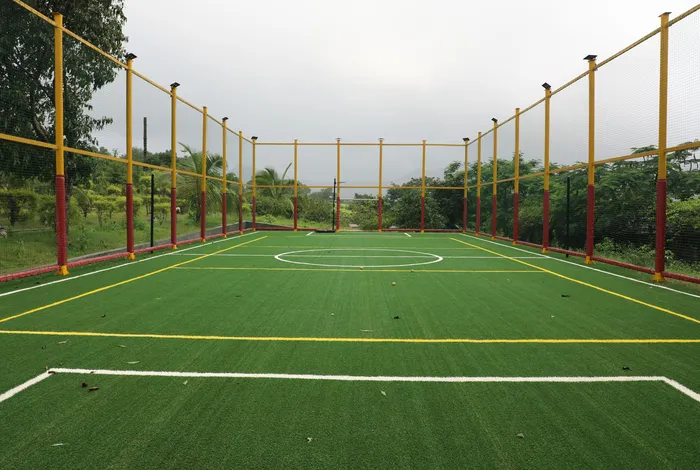
Small-Sided Pitch Sizes: How Big Is a 6+1 or 7+1 Pitch?
The Laws of the Game define no size for 6+1 and 7+1 small-sided pitches. For seven-a-side teams the English FA recommendation of about 55 × 37 m, and for eight-a-side teams the 70 × 50 m used in TFF Istanbul’s U11 league, can serve as references.
Read article ›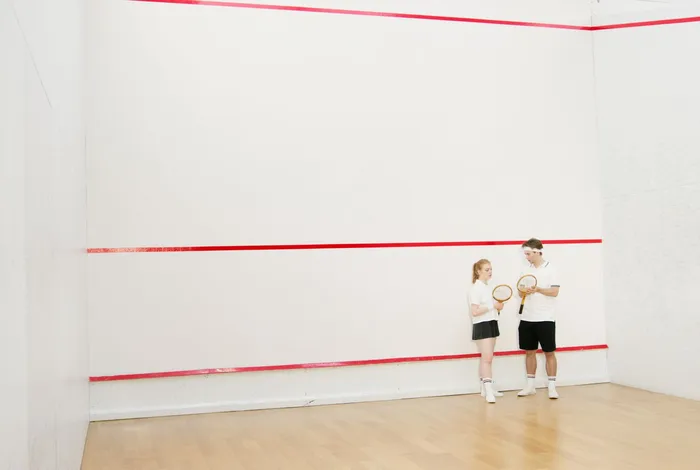
Squash Court Dimensions: Wall Lines and Floor
An international singles squash court is 9.75 m long and 6.40 m wide. The front wall line is at 4.57 m, the service line at 1.78 m and the back wall line at 2.13 m; the top of the tin is 48 cm above the floor.
Read article ›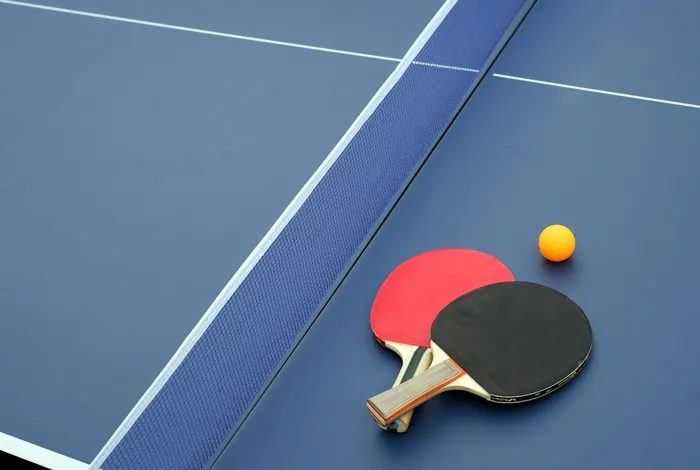
Table Tennis Table Dimensions: Height, Net and Playing Surface
A table tennis table has a playing surface 2.74 m long and 1.525 m wide, 76 cm above the floor. The net stands 15.25 cm above the playing surface. The figures are in chapter 2 of the ITTF Laws.
Read article ›