

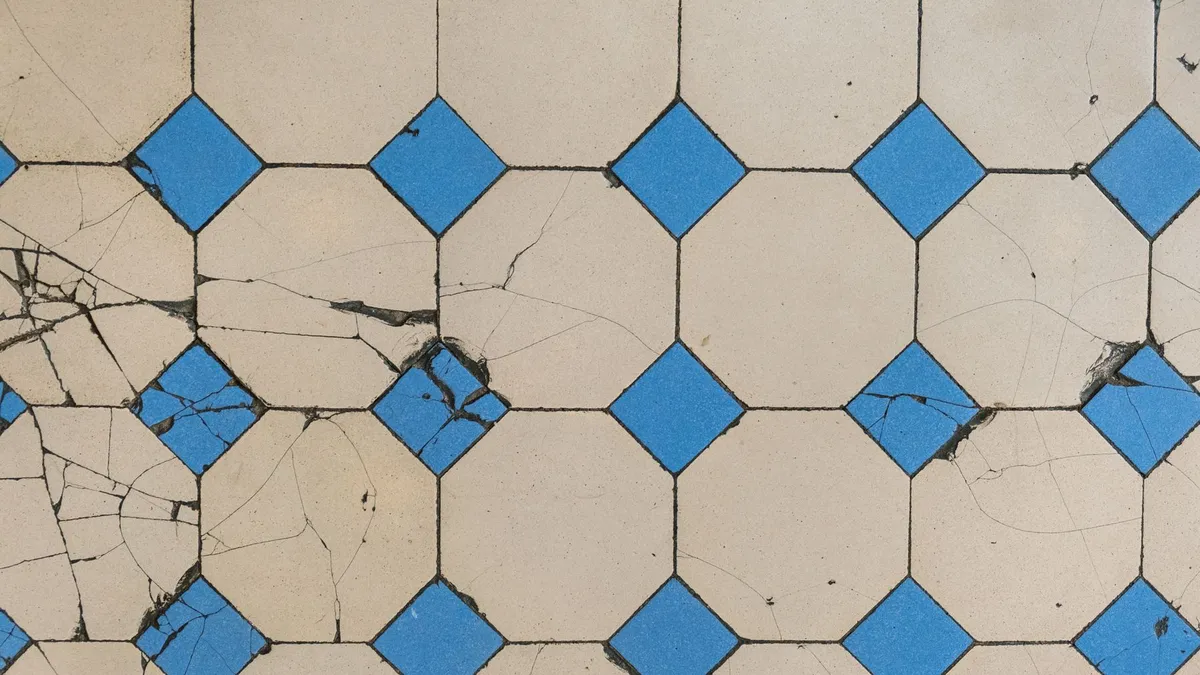
Epoxy can be applied over well-bonded tiles, saving demolition, debris and time. Hollow or loose tiles must be dealt with first.
Why not remove them?
Removing tiles means dust, debris, noise and extra time. A sound tiled floor can be a suitable base for epoxy.
Checking soundness
Tiles are tapped one by one to find hollow ones. Hollow and loose tiles are removed and the gaps filled with mortar.
Surface preparation
The glazed surface is sanded or mechanically roughened so the epoxy can bond, then a suitable primer is applied.
Grout lines
With thin coatings, grout lines can show through as lines. Filling the joints first or choosing a thicker self-levelling system removes them.
When to remove
If many tiles are hollow or there is a moisture problem beneath, removal is the safer route.
Frequently Asked Questions
Can epoxy go over ceramic tiles?
Yes, if the tiles are well bonded and properly prepared.
Will grout lines show afterwards?
They can with thin systems; filling joints or a thicker system prevents it.
When should tiles be removed?
When many are hollow or there is moisture beneath.
Would you like a site survey for your floor? HBK Epoxy Flooring, based in Gaziantep, offers free surveys and quotations in the surrounding provinces.
0507 597 9537 WhatsAppRelated articles
Concrete Moisture Testing: Why and How Before Coating
Concrete can look dry yet hold moisture inside. Under a coating this moisture creates vapour pressure; work started without testing may later blister.
Read article ›
Stains and Scratches on Epoxy Floors: Prevention, Cleaning and Renewal
Epoxy is tough but not scratch-proof. Most stains come out with correct cleaning; deep scratches are removed with a topcoat renewal without removing the floor.
Read article ›
Anti-Slip Epoxy: How to Choose the Right Texture
More texture is not always better: too much makes cleaning harder. The right level depends on how wet and oily the area is.
Read article ›